



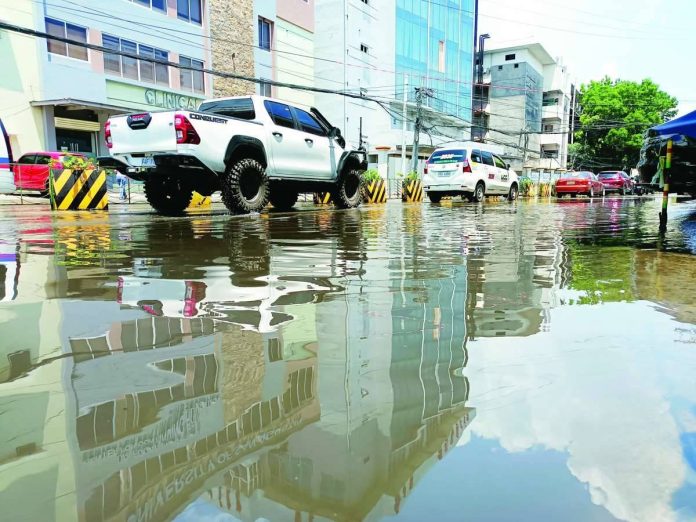
ILOILO City — Even without heavy rains brought by storms or monsoon weather, major streets here still experienced flooding.
A malfunctioning floodgate allowed seawater to surge into drainage channels during high tide, exposing the vulnerability of the city’s flood control system amid the peak of the dry season.
The City Engineers Office (CEO) identified a burnt motor pump at a flood control gate along Jalandoni Street in the City Proper as the cause of the seawater intrusion that inundated low-lying areas, including portions of General Luna Street, Delgado Street, and Valeria Street during high tide.
Engr. Mavi Gustilo, officer-in-charge of the CEO and head of the Office of the Building Official, said the damaged motor prevented the floodgate from closing at a crucial time, allowing seawater from nearby rivers and coastal channels to flow back into the drainage system.
She acknowledged that the incident demonstrated how dependent Iloilo City’s flood mitigation system is on fully functioning pumping stations and mechanical floodgates, especially during high tide conditions when gravity alone cannot stop seawater backflow.
The CEO head explained that floodgates are specifically designed to block tidal inflows once closed, but because the motor pump malfunctioned, the system failed to operate, resulting in uncontrolled seawater intrusion into the drainage network.
The city engineer also clarified issues surrounding the management and operation of the floodgate system, saying operational responsibilities had previously been handled by different offices and personnel.
According to Gustilo, floodgate operations were earlier supervised by Engr. Padong Pedrigosa of the Facility Office, while oversight is now reportedly under another assigned engineer.
However, Gustilo said it remains unclear whether a formal turnover of full operational control has already been completed.
Authorities said flooding in Jalandoni Street and nearby areas is heavily influenced by tidal activity and drainage conditions, particularly when seawater levels rise and exposed inlet points remain open or compromised.
Public concern has repeatedly surfaced over recurring flooding in the area, but engineers pointed out that high tide conditions intensified by climate variability continue to pose serious challenges, especially when flood control mechanisms fail.
Gustilo also cited the large detention tank in front of the University of San Agustin, which was designed to absorb runoff from upland catchments and portions of Jalandoni Street.
The structure has substantial capacity, but flooding can still occur if water accumulation exceeds discharge capability or pumping systems fail to function properly, said Gustilo.
“In situations where water is not discharged through pumps, it will naturally accumulate,” Gustilo said.
She emphasized that Iloilo City’s flat terrain makes pumping stations critical because natural drainage alone is insufficient to move water efficiently toward the sea.
Additional pumping facilities have already been installed by the Department of Public Works and Highways – Regional Office 6 to supplement earlier systems constructed by the Iloilo City District Engineering Office.
Gustilo recommended stricter and more proactive monitoring of tide schedules and water levels, saying flood control operations should be synchronized with predictable high tide and low tide cycles to minimize overflow incidents.
She also urged operators to optimize pumping activities by gradually discharging water even during rising tides instead of waiting for critical water buildup.
Meanwhile, pumping station operator Arlon Macahilo confirmed that the floodgate became inoperable after its motor burned out.
“Flood gate kun mag high tide, gina-close. Nasunog ang motor sang flood gate, so halin pa sang Huwrbes wala masirado,” Macahilo said.
The CEO said assessment and repair works are expected to restore the flood control system’s full functionality and prevent similar flooding incidents during future high tide events./PN