


ILOILO — Gov. Arthur Defensor Jr. has thrown a challenge to conventional flood-control spending, declaring that Iloilo’s best protection against recurring floods lies in restoring its forests, not in pouring billions into concrete structures.
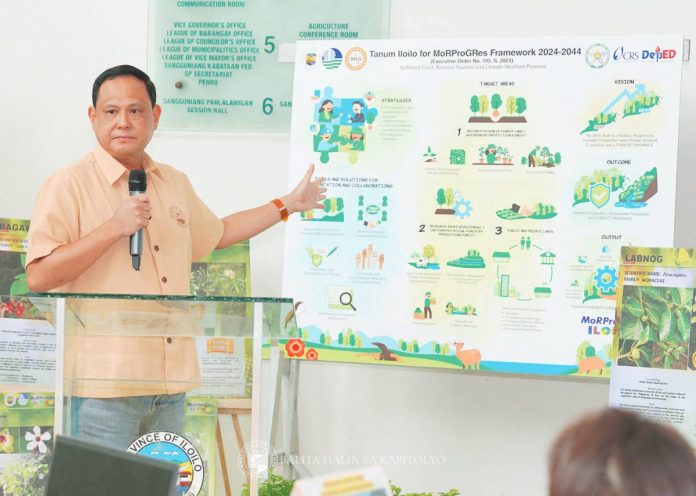
“The forest is the best flood control project,” Defensor said at the launch of the 25th Piyesta sa Kakahuyan celebration on Monday at provincial capitol grounds. “Reinforcing the health of our forests is paramount, as they serve as nature’s most effective flood control mechanism.”
Defensor’s remarks come as Iloilo continues to grapple with flooding. Ironically since 2022, over 160 flood control projects worth billions of pesos have been carried out in this province, data from President Ferdinand Marcos Jr.’s newly launched “Sumbong sa Pangulo” website showed.
“Sumbong sa Pangulo” is an online platform for reporting public works issues. The database lists projects across multiple Iloilo municipalities.
Defensor said that healthier and more robust forests offer a natural, sustainable solution, directly contributing to safer communities by mitigating floods, improving air quality, and conserving biodiversity.
Guided by Executive Order 195, or Tanom Iloilo for More Progress, the province’s forest strategy focuses on three areas:
* restoring primary forests in upland towns
* creating livelihoods through social forestry areas, and
* utilizing both public and private lands for tree planting
“We aim to dedicate the entire month of September to prepare and promote initiatives that will propel our vision forward,” Defensor said.
The opening program yesterday drew local leaders and environmental partners, including Vice Gov. Lee Ann Debuque, Regional Director Red Raul Lorilla of the Department of Environment and Natural Resources (DENR) Region 6, Provincial Administrator Raul Banias, Oton mayor Sofronio Fusin, Maasin Municipal ENR Office chief Noemi Magullado, Provincial ENRO chief Cesar Emmanuelle Buyco Jr., and United Nations Development Program representatives.
Lorilla called the celebration “a symbol of a united community committed to rehabilitating our forests and preserving our natural heritage for future generations,” while Buyco said it is a significant step toward “fostering a cleaner, healthier, and greener province.”
Now on its 25th year under Provincial Ordinance No. 2000-040, Piyesta sa Kakahuyan has grown into a rallying point for environmental action.
By positioning forest restoration as a key to flood prevention, Iloilo is reframing its resilience strategy — from relying on flood-control infrastructure to investing in nature itself.
As for flood control projects, 5th District Provincial Board member Rolex Suplico renewed his call for a full-scale probe , specifically on those in his district. The projects were worth nearly P855.6 million, he said.
Suplico said his inspections of seawalls in barangays Pili, Barrido, and Mangorocoro in Ajuy revealed construction flaws and signs of neglect.
In Barangay Barrido, he cited a P39.197-million seawall project which he described as “obviously abandoned.” The total budget for flood control works in the barangay, he said, reached P203.461 million.
In Barangay Pili, Suplico said the first seawall section across the home of Barangay Captain Romeo Bolinas was P85.156 million but lacked a concrete pavement for about 80 meters.
“Water is already seeping in because, during high tide, the canal is filled with seawater,” he noted.
Other sections in Pili, worth P155.8 million in total, were either without foundations or abandoned, he added.
The barangay’s entire seawall project, Suplico said, had a budget of P240.723 million.
In Barangay Mangorocoro, where five seawall sections were awarded to different contractors, Suplico said he found delayed works, demolished old structures, and abandoned portions.
“Grass [was] growing and a pump boat [was] being built on it,” he said of one site.
The total allocation for the barangay was P411.430 million, said Suplico./PN