



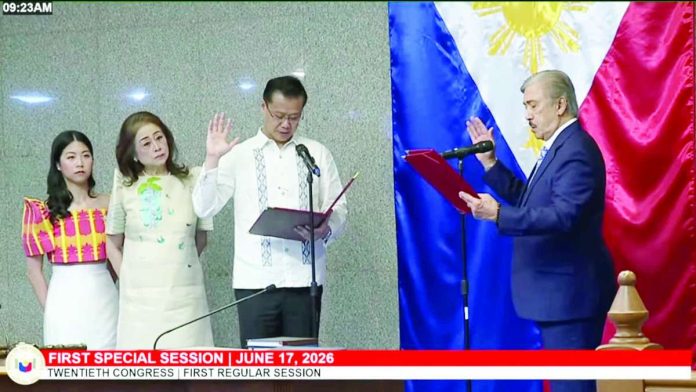
MANILA — The Senate on Wednesday ended nearly two weeks of leadership uncertainty. Sen. Sherwin Gatchalian was unanimously elected Senate President during a special session, paving the way for a reorganization of the chamber and a return to its legislative agenda.
The election capped a prolonged leadership standoff between Gatchalian and Sen. Alan Peter Cayetano that had divided the chamber following competing claims over Senate leadership earlier this month.
Sen. Juan Miguel Zubiri formally nominated Gatchalian for the Senate’s highest post.
Sen. Francis Pangilinan later announced that all 13 senators present voted in favor of Gatchalian, giving him a unanimous mandate to lead the chamber.
Gatchalian subsequently took his oath of office before Sen. Vicente ‘Tito’ Sotto III.
In nominating Gatchalian, Zubiri highlighted the senator’s track record in leading key committees and his ability to steer the institution through a period of internal division.
“He’s the leader that the Senate needs in this time of division and disarray, and he has done this before. I know he’ll be able to rise above the fray and lead us back to our principal function, which is to attend to the work of legislation,” Zubiri said.
“I have every confidence that as Senate president, he’ll be able to set the institution back on the right path, guided by the highest standards of service, integrity and morality. To my colleagues, I plead, let us elect Senate President Gatchalian and let us get back to our work in this hallowed institution,” he added.
A quorum was established after 13 senators attended the special session, including senators Francis Escudero and Joel Villanueva, who had previously been associated with the Cayetano bloc.
The leadership dispute traced its roots to the Senate session on June 3, when 12 senators convened and declared a quorum based on the Supreme Court ruling in Avelino vs Cuenco. During that session, senators voted to declare all elected Senate positions vacant, including the Senate presidency.
Gatchalian was then elected Senate president pro tempore and was recognized by those present as acting Senate president.
With the leadership issue settled, the Senate moved swiftly to reorganize its ranks. The special session elected Sotto as Senate president pro tempore, while Zubiri, who had earlier been chosen as majority leader, assumed the chairmanship of the Committee on Rules.
The chamber also proceeded with the election of chairpersons and members of its permanent committees under the new Senate leadership, signaling a return to regular legislative operations after days of political uncertainty./PN