



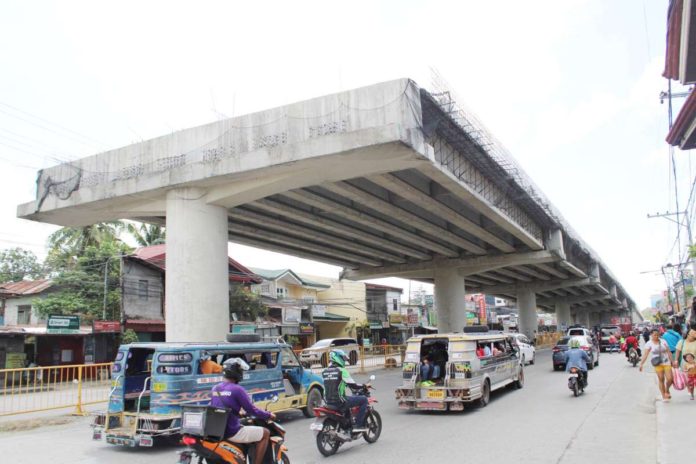
ILOILO – The Department of Public Works and Highways (DPWH) Region 6 plans to commence the geotechnical investigation of the flyover being constructed in Barangay Aganan, Pavia town possibly by the first week of September.
Engineer Sanny Boy Oropel, DPWH regional director, emphasized the urgency of beginning the investigation to facilitate the resumption of construction activities at the Aganan flyover which has an P802-million budget and 50-meter span intersection design.
Geotechnical investigations are crucial for determining the physical properties of the soil and rock beneath the surface at proposed construction sites. This step is essential to ensure successful project execution and to assess potential environmental impacts.
According to Oropel, the evaluation of bid amounts submitted by five third-party consulting firms is currently underway.
“Our technical team is in the process of evaluating the financial statements submitted,” Oropel said in an interview with Panay News.
He anticipates issuing a Notice to Proceed to the winning bidder in the first week of September, enabling them to immediately begin the investigation.
Five bidders from Metro Manila participated in the bidding process. Among them is Abinales Associates Engineers + Consultants which previously conducted a geotechnical study for the defective P680-million flyover in Barangay Ungka 2, Pavia at a cost of P13,480,880.
For the Aganan flyover, which is designed to be 436.90 meters long including the protection approaches, DPWH-6’s choice of the winning bidder will be based on the lowest bid amount and expertise in geotechnical investigations.
The need for third-party consultants arose after inconsistent soil test results were obtained by United Technology Consolidated Partnership (UTCP) and further tests by DPWH-6.
UTCP, hired by the Bureau of Design (BOD) of the DPWH-Central Office, also conducted soil tests and designed both the controversial Ungka and Aganan flyovers.
“We need a consultant to accurately determine the condition of the Aganan bridge because the UTCP data and our confirmatory and seismic tests show differing depths for the firm soil layer,” Oropel explained.
Aware of the issues experienced with the Ungka flyover – it suffered from vertical displacement or sinking due to the softness of the soil on which it stands – and given its proximity and alignment with the Aganan flyover, DPWH-6 anticipates similar challenges to the Aganan infrastructure project.
Meanwhile, Oropel mentioned that the design department has begun drafting plans for the 50-meter center span of the Aganan flyover, proposing a shift from concrete to steel girders to ease installation and reduce traffic congestion during construction.
“Our request to the BOD to revise the material from concrete to steel is mainly due to the difficulties in managing traffic during construction. We expect to release our revised plan for the center span of the Aganan flyover before the end of the geotechnical investigation,” Oropel added.
Construction of the Aganan flyover started in 2020 but work was suspended in December 2022 due to concerns over the soil on which it was being erected./PN