



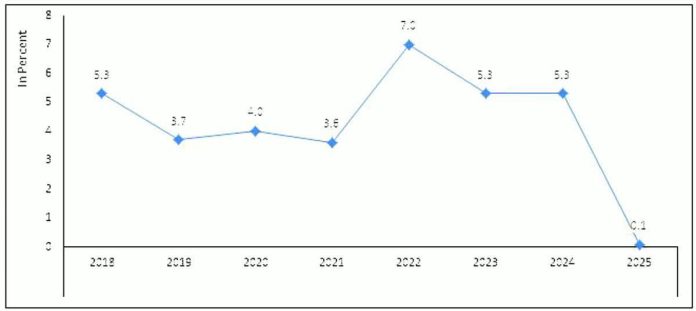
GUIMARAS – The average inflation rate, or the rate of change in consumer prices, in this island province slowed to 0.1 percent in 2025, lower than the 5.3 percent recorded in both 2023 and 2024, based on the latest price statistics released by the Philippine Statistics Authority (PSA).
“In comparison with other geographic levels, Philippines posted an average inflation rate of 1.7 percent in 2025, while Western Visayas recorded 1.5 percent, both higher than Guimaras’ annual inflation rate, indicating lower price increments in the province relative to the national and regional levels during the year,” Provincial Statistics Officer Nelida B. Losare said.
Losare further explained that in terms of historical perspective, Guimaras’ annual average inflation rate generally fluctuated from 2018 to 2025. Inflation declined from 5.3 percent in 2018 to 3.7 percent in 2019, inched up in 2020, and eased again in 2021.
“A sharp spike was observed in 2022 at 7.0 percent, the highest in the eight-year period, before settling at 5.3 percent in both 2023 and 2024. In 2025, inflation dropped significantly to 0.1 percent,” Losare said.
Comparing inflation rates across the provinces in Western Visayas, the region recorded an average inflation rate of 1.5 percent in 2025, lower than the 3.7 percent in 2024.
Inflation levels varied across provinces, ranging from –0.8 percent in Antique to 3.0 percent in Iloilo City. Guimaras posted 0.1 percent, Capiz recorded 0.9 percent, Aklan registered –0.2 percent, while Iloilo Province recorded a higher inflation rate of 2.5 percent, indicating mixed price movements across the region during the year.
Losare further expound that the Consumer Price Index (CPI) in Guimaras for 2025 was recorded at 132.6.
The CPI measures the average change in the prices of goods and services commonly purchased by households over time.
“This implies that a typical Guimarasnon household needs P1,326 in 2025 to purchase the same basket of goods and services worth P1,000.00 in 2018. The stability of the CPI from the previous month reflects the unchanged overall inflation rate of the province,” she added.
Moreover, the Purchasing Power of the Peso (PPP) in the province declined to P0.75 in 2025 from P1.00 in 2018, which means that one peso in 2025 could only buy goods and services equivalent to 75 centavos in 2018 prices./PN