



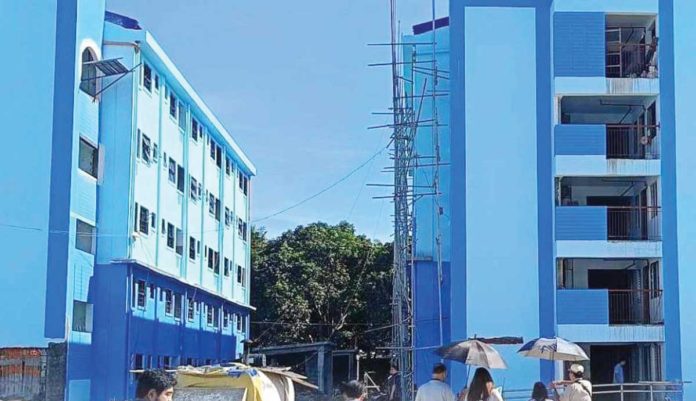
ILOILO – Western Visayas requires 495,268 housing units to address the backlog from 2013 to 2017.
The backlog includes those living in their parents’ homes, the homeless or displaced, and individuals residing in homes they do not own, data from the Department of Human Settlements and Urban Development (DHSUD) Region 6 showed.
DHSUD is thus urging local government units (LGUs) and developers in Western Visayas to participate in the national housing initiative, Pambansang Pabahay Para sa Pilipino (4PH) Program. This aims to accelerate the region’s response to its growing housing backlogs and future demand for housing units.
Eva Maria Marfil, DHSUD Region 6 director, said the region needs about 400,000 units based on current housing needs. She presented the housing unit backlog per province and highly urbanized city as follows:
* Aklan – 33,975 units
* Antique – 52,178 units
* Capiz – 35,320 units
* Guimaras – 6,633 units
* Iloilo – 136,628 units
* Negros Occidental – 164,799 units
* Bacolod City – 35,787 units
* Iloilo City – 29,948 units
Nationally, the total housing demand stands at 6.5 million units.
As of this month, only 30 housing projects are ongoing in Western Visayas addressing the backlog: Aklan (one project), Antique (four projects), Capiz (eight 8 projects), Iloilo (eight projects), Negros Occidental (nine projects).
For LGUs interested to participate in the 4PH Program, Marfil emphasized the need for them to identify available residential lots for constructing condominium-type housing units, and to collaborate with developers or investors willing to fund the construction.
Once a suitable lot is identified and a developer is found, LGUs can enter into a memorandum of agreement with DHSUD.
Under the 4PH program, interested buyers must be enrolled in the Home Development Mutual Fund, commonly known as the Pag-IBIG Fund, and have made contributions for at least 24 months.
However, those not yet enrolled can make an advance payment for 24 months to qualify for a housing loan.
Once enrolled, the national government will subsidize half of the buyer’s housing loan, while DHSUD will cover five out of the six percent interest rate on the Pag-IBIG housing loan.
Marfil clarified that the program is open to all first-time homebuyers, not just informal settlers.
Potential beneficiaries include informal settlers, displaced or homeless individuals, and those living with their parents.
DHSUD aims to extend the program to migrant workers this year, encouraging them to start inquiring with their LGUs or DHSUD on how to avail themselves of the program.
Marfil advised potential beneficiaries to inquire early to understand the requirements and be prioritized once construction begins.
The slow uptake of the 4PH program by LGUs in the first three years prompted DHSUD to intensify its campaign to encourage participation.
Currently, DHSUD is conducting stakeholders’ forums with LGUs and developers to guide them on how to avail themselves of the program.
“We are now in the massive marketing phase of our program. Although we had a slow start over the last three years, we are faring better than other regions. Some regions are only just starting due to challenges such as a lack of developers or available land. Here, we also face challenges, particularly a shortage of local developers capable of investing full-scale,” Marfil said./PN