


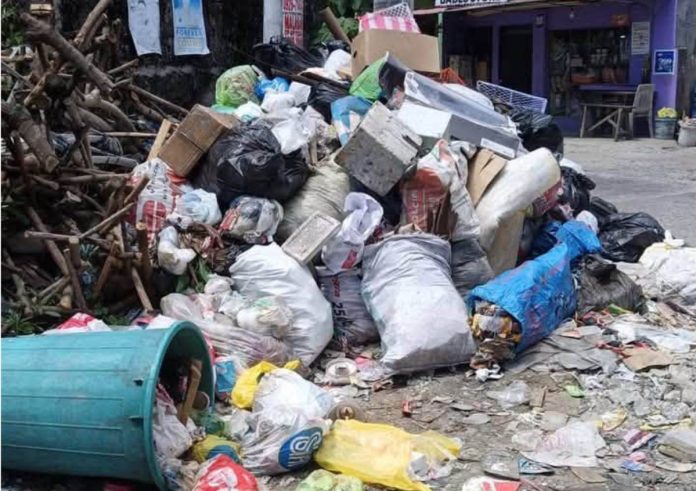
ILOILO City – The city government is investigating whether garbage from neighboring municipalities is adding to the metro’s mounting waste problem.
Iloilo City’s solid waste management system is under growing pressure as only about 30 percent of its 180 barangays have functional Material Recovery Facilities (MRFs).
The General Services Office (GSO) said the twin challenges — poor compliance with Republic Act 9003 and the apparent influx of waste into boundary barangays — are straining efforts to manage the city’s more than 600 tons of daily garbage.
“One of the things that we see as alarming are the boundary barangays that have increased their solid waste, such as Santo Niño Sur in Arevalo district; Ungka, Tacas, Buhang, and Bitoon in Jaro district; and Hibao-an in Mandurriao district. These are areas located along the city’s boundaries,” GSO head Engr. Neil Ravena said.
Arevalo is adjacent to Oton, Iloilo while Mandurriao is next to San Miguel, Iloilo. barangays Ungka and Tacas in Jaro district, on the other hand, are adjacent to the town of Pavia. Bitoon, also in Jaro, is adjacent to the municipality of Leganes.
“We are monitoring whether some of the waste is also coming from the province, particularly in areas like Ungka and Hibao-an,” he added.
To determine the source of the increasing waste volume, the city government has organized monitoring teams composed of barangay officials, the GSO and the City Environment and Natural Resources Office (CENRO) to inspect waste collection and disposal practices.
“We want to ensure that waste management policies are being properly implemented,” Ravena said.
Ravena admitted that compliance with Republic Act 9003, or the Ecological Solid Waste Management Act, remains one of the city’s biggest hurdles, particularly because many barangays have yet to establish their own MRFs.
“Republic Act 9003 clearly states that local government units are not mandated to collect unsegregated waste. But at the same time, we don’t want Iloilo City to become dirty. That’s why we’re trying our best to improve compliance because everything starts at the barangay level,” he said.
The law requires every barangay to operate an MRF where recyclable and biodegradable wastes are segregated before only residual waste is transported to the sanitary landfill.
However, Ravena said many barangays still rely on agreements with junk shops to recover recyclable materials while organic waste continues to be mixed with regular garbage.
“Many barangays have memoranda of agreement with junk shops where recyclable materials are sold. But the question is, what happens to the organic waste? Food waste and kitchen waste are still mixed with the general waste because there are no composting facilities,” he explained.
To address the shortage of composting areas — particularly in more than 40 barangays within the city’s central business district — the city is constructing an Integrated Solid Waste Management Facility (ISWMF) in Calajunan, Mandurriao.
The facility, expected to become operational in the second quarter of next year, will feature an anaerobic digestion system capable of processing 200 to 300 tons of organic waste daily.
“Once operational, it will solve the problem of organic waste, especially in the central business district where composting facilities are not feasible,” Ravena said.
The city is also planning to deploy mobile MRFs to collect biodegradable waste from communities without permanent facilities.
Ravena also disclosed that the United Nations Development Programme (UNDP) has donated two electric food waste collection trucks to Iloilo City. Their rollout, however, has been delayed while a fast-charging station is being completed in Calajunan.
“Since these are electric vehicles, we needed a charging station. Originally, charging took about 24 hours, so we redesigned the system into a two-hour fast charger. It’s currently being installed in Calajunan, and once completed, it will support our daily collection operations,” he said.
Despite the current challenges, Ravena expressed optimism that the ISWMF, designed to process up to 400 tons of waste daily, will significantly improve the city’s waste management capability.
Iloilo City currently generates more than 600 tons of garbage every day, with an estimated 200 tons consisting of recyclable materials./PN