



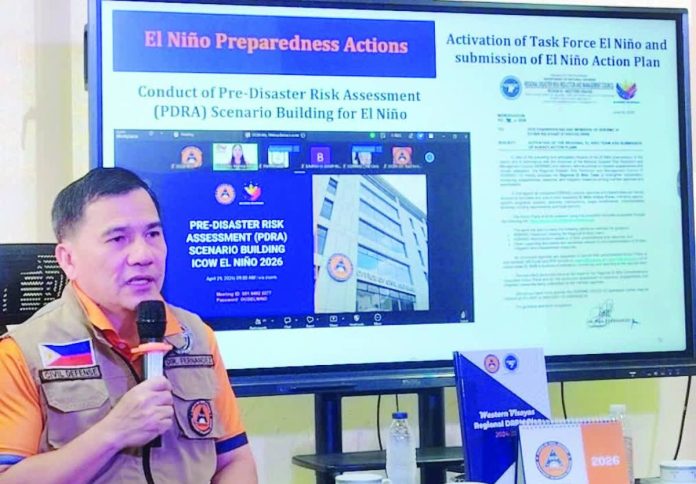
ILOILO City – Western Visayas has stepped up its disaster preparedness measures after forecasts indicated that the looming El Niño phenomenon could intensify into a “strong” or “very strong” event by late 2026, prompting the Office of Civil Defense (OCD) to activate Task Force El Niño and roll out a comprehensive regional action plan to protect communities from its expected impact.
The heightened preparations follow projections from the Philippine Atmospheric, Geophysical and Astronomical Services Administration (PAGASA) that El Niño conditions could begin early, raising concerns over prolonged dry conditions that may affect water supply, agriculture, energy, public health, and emergency response across the region.
El Niño is a climate pattern marked by the unusual warming of surface waters in the central and eastern tropical Pacific Ocean. It can disrupt normal weather patterns and bring below-normal rainfall, prolonged dry spells and hotter conditions to the Philippines, increasing the risk of water shortages, crop losses, pressure on power supplies and heat-related illnesses.
OCD Region 6 director and Regional Disaster Risk Reduction and Management Council (RDRRMC) chairperson Raul Fernandez said government agencies are working together to ensure every vulnerable sector is covered by mitigation measures.
The regional disaster council has prioritized the activation of Task Force El Niño to coordinate government interventions and ensure that no community is left unprepared for the anticipated climatic event.
Among the task force’s major initiatives is the formulation of a comprehensive El Niño Regional Action Plan that outlines strategies covering water resources, agriculture, energy, health services, emergency response, and other critical sectors.
“Proactive planning empowers both governmental agencies and local government units (LGUs) to implement essential mitigation measures that can significantly reduce the severe impacts of El Niño,” Fernandez said.
He also urged local governments to adopt Pre-Disaster Risk Assessment (PDRA) scenario-building exercises to evaluate potential risks and strengthen community resilience before the dry spell intensifies.
Beyond planning, OCD-6 has launched climate forums in higher education institutions across Western Visayas to increase awareness of climate adaptation and encourage collaboration among students, educators, and researchers in building resilient communities.
The agency has likewise identified seven priority areas, including strengthening climate and disaster resilience across sectors, improving community preparedness, and enhancing emergency communication systems to ensure timely dissemination of information.
Fernandez said Western Visayas is building on lessons learned from the 2024 El Niño episode, with existing programs now being refined to better address the anticipated effects of another prolonged dry season.
“Our goal is to ensure that all programs address the needs of affected sectors, leaving no one behind,” he affirmed.
The RDRRMC is expected to convene its Task Force El Niño after member agencies submit their respective action plans, while ongoing pre-disaster risk assessments continue to evaluate the potential impact of the phenomenon on water supply, agriculture, energy, and public health across Western Visayas./PN