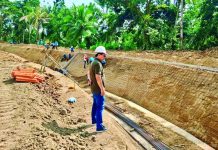




THE JALAUR River Multi-Purpose Project Stage II has been sold on a grand promise: store water when it is abundant and deliver it when Iloilo’s farms desperately need it. Now, with a potentially severe El Niño bearing down on the province, that promise is about to face perhaps its most consequential test.
And this test matters far beyond the P25.66 billion invested in the project. It is a test of whether massive public infrastructure can actually translate billions of pesos, years of construction and engineering ambition into something painfully simple for farmers: water when there is no rain.
The early signs are encouraging. Although JRMP II is not yet fully operational, some 500 hectares of farmland in barangays Badu, Aglibacao, Lonoy, and Alibunan in Calinog town are already receiving irrigation water. About 50 hectares even managed a third crop this year because of continuous irrigation.
More significantly, the National Irrigation Administration says water from the reservoir can augment supply reaching around 10,000 hectares downstream in the municipalities of Dingle, Pototan and Barotac Nuevo.
That is precisely what a project of this magnitude should be doing.
JRMP II’s reservoir can hold 250 million cubic meters of water and currently contains about 112 million cubic meters. The principle behind it could hardly be more straightforward: capture water during the rainy season, store it, and release it during the dry months.
Now nature may conduct the ultimate performance audit.
A dam should not be judged by how imposing it looks when the reservoir is full. Its true worth is measured when the rivers shrink, the soil cracks and farmers look to the sky for rain that refuses to come.
This is why the coming dry spell must be treated beyond being an agricultural emergency. It should be regarded as a real-world stress test of JRMP II — its reservoir management, canals, distribution system, operating protocols and the government’s ability to deliver water where and when it is needed most.
There is, however, no room for complacency. The project remains unfinished. As of August 2026, JRMP II was more than 87 percent complete, but substantial portions of its High Line Canal and main and lateral canals still have to be finished. Full operation is targeted only by the end of 2027 or the first quarter of 2028.
A reservoir holding millions of cubic meters of water means little to a farmer if the infrastructure needed to bring that water to his field remains incomplete. That makes completion of the irrigation network urgent. Every unfinished canal represents farmland that may remain beyond the reach of the very water the government spent billions to impound.
NIA must therefore resist any temptation to treat the project’s high completion percentage as the finish line. Farmers do not irrigate their fields with completion percentages. They need actual water.
Neither should JRMP II become an excuse for government agencies and local governments to relax their preparations for El Niño. Reservoir water is finite. It must be carefully allocated, losses minimized, irrigation schedules enforced and farmers guided toward efficient water use. Agriculture, domestic consumption and other competing requirements will become increasingly difficult to balance if the dry spell intensifies.
The approaching El Niño will reveal whether Iloilo has merely built a monumental piece of infrastructure or created genuine climate resilience.
For years, Ilonggos have heard about JRMP II’s enormous cost, massive reservoir, sprawling canal system and transformative potential. Those figures are impressive on paper.
But infrastructure ultimately earns public confidence by working when people need it most.
If the rains fail and JRMP II succeeds in keeping Iloilo’s farms green, crops growing and farmers productive, then the province will finally begin collecting the most important return on its P25.66-billion investment.
The super El Niño may be Jalaur’s sternest test yet. It is also the mega dam’s opportunity to prove why it was built.