



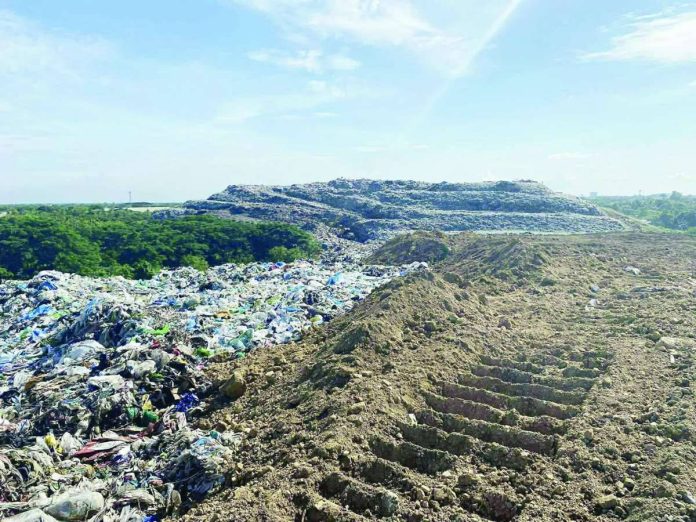
ILOILO City – This city is preparing to permanently phase out its decade-old sanitary landfill in Barangay Calajunan, Mandurriao district and transition to a modern waste-to-energy facility that could convert up to 90 percent of the city’s garbage into usable energy, marking a major shift in the city’s waste management strategy.
The move comes as the Calajunan sanitary landfill, which receives about 400 tons of waste daily from Iloilo City and neighboring local government units, is expected to reach the end of its designed 10-year operational lifespan by the fourth quarter of 2026, according to city officials.
Engineer Neil Ravena, head of the General Services Office (GSO), said the city is now racing to complete its Integrated Solid Waste Management Facility, which includes a waste-to-energy component, before the landfill reaches capacity.
“By the fourth quarter of this year, the landfill will have reached its 10th year of operation. Based on the feasibility study, its lifespan was designed for only 10 years,” Ravena said.
The landfill began operations in 2016 and currently serves Iloilo City as well as the municipalities of Oton, Pavia and San Miguel.
Ravena said project proponents have assured the city that all major equipment for the waste-to-energy facility will be installed by the fourth quarter of this year.
“Based on our meetings with the proponents of the waste-to-energy project, all equipment should be installed by the fourth quarter. By February next year, we will begin testing operations,” he said.
During the testing phase, waste collected from the city will be processed through the new facility while environmental indicators, including air emissions, water quality and exhaust outputs, are monitored.
“We will collect data from the processing of our waste and submit these to the Department of Environment and Natural Resources (DENR) for evaluation. Once the environmental requirements are met and all results comply with the standards set by regulations, we can proceed with full operations,” Ravena explained.
But he clarified that the landfill will not immediately cease operations at the end of the year. Instead, a transition period will be observed while the new facility undergoes testing and secures regulatory clearances.
Asked when landfill operations would officially cease, Ravena said, “As soon as the new facility becomes operational.”
He added: “We are still in the transition period. We will be applying for a closure plan, which will be submitted to the DENR.”
The city has also prepared contingency measures in case the waste-to-energy project experiences delays.
“If the facility’s operation is delayed, we can still accommodate incoming waste. We anticipated that possibility. However, we will need to apply for an extension of the landfill’s lifespan, and the DENR will conduct inspections before making a decision,” Ravena said.
CALAJUNAN SAFETY RECORD
Despite the Calajunan landfill nearing the end of its lifespan, Ravena highlighted its safety record, noting that it has avoided major incidents that have affected other landfill sites in the country.
“We have not experienced a waste avalanche or landfill fire. Several landfill facilities in other areas have experienced fires and waste collapses, but we have managed to avoid those incidents,” he said.
According to Ravena, proper landfill management practices have played a crucial role in maintaining the site’s stability.
He cited the regular application of soil cover, strict adherence to slope engineering standards, and adequate equipment support as key factors that prevented accidents.
“One reason landfills collapse is the decomposition of mixed waste. Organic waste eventually breaks down and creates voids that can destabilize the structure. If a landfill is not properly designed and maintained, the waste mass can collapse,” Ravena explained.
He added that sanitary landfill operations require continuous slope management and soil covering to control odor, maintain stability, and prevent environmental hazards.
“The landfill has to be properly shaped and landscaped. Soil cover is essential not only to minimize odor but also to maintain the integrity of the landfill structure,” he said.
Once the landfill is permanently closed, the city plans to rehabilitate the 33-hectare site through a process known as bioremediation.
Ravena said the long-term goal is to restore the area and make it suitable for other future uses.
“We are looking for proponents who can undertake the bioremediation of the area. The objective is to bring the site back to its original state,” he said.
Under the proposed process, buried waste will be excavated and segregated. Decomposed organic materials will be processed and reused for soil recovery, while plastics and other non-biodegradable materials will be transferred to the new facility for treatment and processing.
“The organic waste has already decomposed and can potentially be used for soil recovery. The remaining plastics and other non-degradable materials will be processed through the new facility. Ultimately, the goal is to restore the area so it can be safely used for other purposes,” Ravena said./PN