



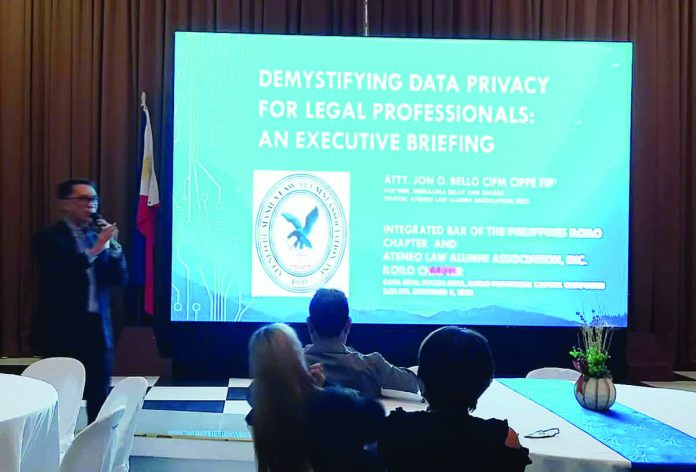
ILOILO City – As privacy, cybersecurity, and data-handling regulations continue to shift at unprecedented speed, Iloilo’s legal community is being urged to intensify its capacity-building efforts to ensure lawyers and stakeholders can provide accurate, compliant, and practical counsel to clients across all industries.
This call for stronger institutional and professional readiness emerged during the executive briefing “Demystifying Data Privacy for Legal Professionals” organized by the Ateneo de Manila Law Alumni Association, Inc. (ALAAI) at the Casa Real Social Hall of the Iloilo Provincial Capitol on Friday last week, December 5.
Leading the session was data privacy expert Atty. Jon O. Bello, who emphasized that rapidly evolving digital landscapes demand well-equipped legal practitioners capable of interpreting the Data Privacy Act in real time — and correcting widespread misconceptions that could expose organizations to serious liabilities.
According to Bello, the briefing was organized precisely to close knowledge gaps and strengthen the advisory role of the legal profession. He said the activity is a knowledge-sharing effort “to understand the Data Privacy Act kag very important ini sa tanan bangod nga the moment we are born, the law applies already to all us.”
“Halimbawa sini, kon magpa-check-up sa doctor or school, the data privacy law applies,” he added.
Lawyers must lead in correcting misconceptions
Bello stressed that the legal sector must be equipped to navigate the complexities of privacy-related decisions that affect hospitals, schools, businesses, and government agencies.
“We need to have this knowledge sharing activity so we can raise awareness of individuals not just the schools and hospitals, but also the lawyers because the lawyers are the ones who advised their clients about data privacy act. So, we need to assist the lawyer’s right to have a grasp what the law is,” he said.
He highlighted recurring misconceptions — such as the belief that doctors must obtain patient consent before gathering medical information, or that employers need explicit consent from newly hired employees before collecting personal data.
These misunderstandings, Bello explained, often hamper efficient processes and put institutions at unnecessary risk.
“We need to equip the lawyers, the members of the IBP as well as the member of the ALAAI here in Iloilo to have the right the skills, knowledge and foundation on data privacy so they can themselves be consultant for their clients and they will be the one who will be sorting out the misconception and in the confusion about the law,” he stressed.
High penalties underscore urgency
Bello warned that many industries still lack designated Data Protection Officers (DPOs), despite steep penalties for non-compliance — up to 3% of total gross annual income, with possible imprisonment of up to seven years for severe violations.
Awareness, he said, must expand beyond the legal circle to all sectors handling personal data.
ALAAI: Lawyers must stay ahead of the curve
Atty. Beato Alessandro C. Dela Cruz III, ALAAI president, said the organization brought the briefing to Iloilo because the accelerating pace of technological and regulatory developments demands constant upskilling.
“We acknowledge that we need to update our lawyers here in the provinces because there are emerging trends in the legal profession that has to be studied and to be taken into consideration by all the practitioners,” Dela Cruz said.
He added that the lecture also targets stakeholders who lack internal data governance structures:
“We are well aware nga this has to be disseminated and in the process we should help other practitioners and also stakeholders na they take this into careful consideration.”
The session drew lawyers, academics, health institutions, and private-sector representatives—underscoring mounting recognition that privacy compliance and cybersecurity readiness are no longer optional but essential pillars of modern governance and legal practice./PN