



ILOILO City — Gaps in basic safety ordinances among local government units (LGUs) in Western Visayas are raising red flags, with the Department of the Interior and Local Government (DILG) warning that inaction at the local level could open the door to disorder, unchecked disturbances, and weakened community protection.
Despite having the authority — and responsibility — to legislate for public welfare, several LGUs remain without essential measures regulating public drinking, excessive noise, curfew for minors, and even basic standards of public decency — exposing what observers may view as a troubling lapse in local governance.
“Public safety is a shared responsibility,” stressed DILG Region 6 director Juan Jovian Ingeniero.
But the data suggests that responsibility is not being equally carried.
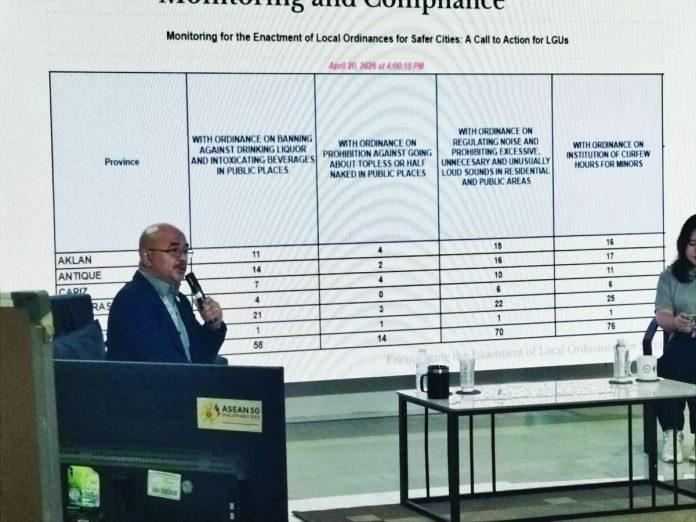
Figures from DILG-6 reveal uneven — and in some areas alarmingly thin — compliance: only 58 LGUs have ordinances banning public drinking, 70 have noise regulations, and 76 enforce curfews for minors.
Most glaring is the near absence of public decency laws, with just 14 LGUs enacting such measures across the region.
Here’s the breakdown:
* Ordinances banning public drinking and intoxicating beverages in public places – Aklan (11), Antique (14), Capiz (7), Guimaras (4), Iloilo (21), Iloilo City (1)
* Ordinances against going about topless or half-naked in public places – Aklan (4), Antique (2), Capiz (4), Guimaras (0), Iloilo (3), Iloilo City (1)
* Ordinances regulating noise and prohibiting excessive, unnecessary, and unusually loud sounds in residential and public areas – Aklan (15), Antique (16), Capiz (10), Guimaras (6), Iloilo (22), Iloilo City (1)
* Ordinances on curfews for minors – Aklan (16), Antique (17), Capiz (11), Guimaras (6), Iloilo (25), Iloilo City (1)
In certain provinces, compliance in specific categories is virtually nonexistent — raising questions about legislative priorities and enforcement seriousness at the grassroots level.
“These may seem like ordinary concerns, but if left unchecked, they can escalate into broader public safety issues,” Ingeniero warned.
DILG-6 has identified these so-called “ordinary” issues as the very cracks where bigger problems begin — street disturbances, youth-related incidents, and community tensions that could have been prevented with clear, enforceable rules.
“Addressing these concerns is crucial; they may appear ordinary but are foundational for the long-term health of our communities,” Ingeniero said.
The agency has intensified its call for LGUs to act decisively, offering assistance while making it clear that delays in legislation carry real consequences for public order.
At the same time, DILG-6 renewed its push for accountability under the Anti-Epal policy, disclosing that 18 complaints have already been filed — an indication that governance issues extend beyond missing ordinances to how public officials present government projects.
“The Anti-Epal policy carries a powerful message — public acknowledgment should belong to the institution that serves the public, not to individual personalities,” Ingeniero said.
While noting improving compliance in some areas, the agency underscored that progress must be matched with urgency.
“We are continuously monitoring compliance and ready to assist local government units with the necessary resources and guidance for effective implementation,” Ingeniero assured.
“We in Region-6 remain committed to working hand in hand with our LGUs and stakeholders in promoting transparency, strengthening institutions, and keeping our communities safe,” he added./PN