

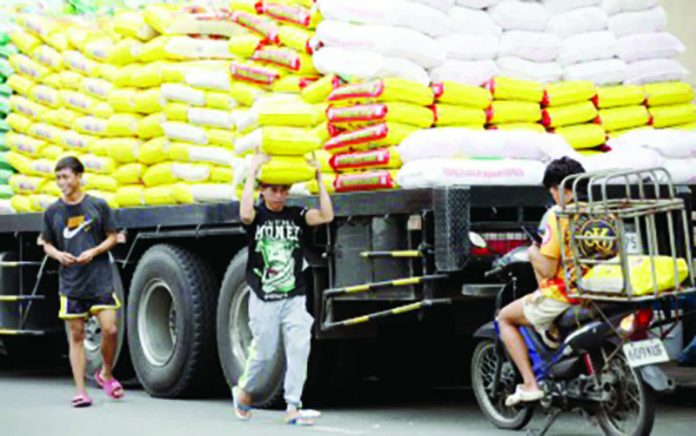
THE DEPARTMENT of Agriculture (DA) assured there will be no upward trend in the retail prices of imported and local rice amid the lean months in the country.
DA spokesperson Assistant Secretary Arnel de Mesa said supply and prices will remain stable as the government has given the green light to resume rice importation following a good rice harvest during the four-month import ban.
“Wala namang inaasahang mataasang pagtaas kasi naging maganda naman ‘yung (There’s no expected high uptick of prices because we have a good) production,” he said in a press conference on January 8.
With a good local palay (unhusked rice) harvest in 2025, the country’s overall rice imports settled at 3.37 million metric tons (MMT) with the import ban in place – much lower than the record-high 4.8 MMT in 2024.
With the resumption of rice importation, De Mesa said imported rice is expected to reach the market within the month, which will help maintain stable market prices.
As of January 7, the average price of premium or 5-percent broken imported rice in Metro Manila is P50 per kilogram (kg), with prices ranging from P45 to P56/kg, according to the DA-Bantay Presyo (price watch).
The prevailing price of imported well-milled rice, meanwhile, is P47/kg, and P42/kg for imported regular-milled rice.
For local rice, the prevailing price of premium variety is P50/kg; well-milled for P45/kg; and regular milled for P40/kg.
The Bureau of Plant Industry (BPI) has also issued the updated measure on rice importation to ensure protection to local farmers and consumers, De Mesa said.
“Effective Jan. 1, nag-start na uli ng importation pero may mga selected ports of entry lang para mabantayan nang husto (the importation has already started, but only in selected ports of entry to ensure stringent monitoring),” he said.
These include the ports in Subic, Batangas, Cebu, Cagayan de Oro, Iligan, Davao, General Santos, Tacloban, Tabaco in Albay, Zamboanga, Bacolod, Iloilo, Tagbilaran, Dumaguete, Calbayog, the Manila International Container Port (MICP), and Port of Manila.
Under the BPI’s guidelines, all imported rice shipments must arrive in the country within 60 days upon the issuance of the sanitary and phytosanitary import clearance (SPSICs).
DA Secretary Francisco Tiu Laurel Jr., meanwhile, said the DA may adjust the current P43 per kilogram maximum suggested retail price (MSRP) for 5 percent broken imported rice.
“Alam naman natin na nag-devalue tayo yesterday to P59.33, then kung ganiyan pa rin ang exchange rate by Jan. 16, plus the 5 percent increase (tariff on imported rice), malamang mag-isyu tayo ng new MSRP na (We know that our peso devalued to P59.33 to the dollar. If the same exchange rate remains by Jan. 16, plus the 5 percent tariff increase, we will probably issue a new MSRP of) P45 per kilo to address the reality,” he said during the Palace briefing on Jan. 8.
The DA chief said the tariff council agreed to increase the tariffs on imported rice to 20 percent from the current 15 percent.
The tariff adjustment will take effect on Jan. 16. (PNA)