


BACOLOD City — Former rebels and more than 5,000 residents of upland communities in Cadiz City, Negros Occidental, are expected to benefit from P78.9 million worth of government infrastructure projects aimed at strengthening peace, improving rural connectivity and expanding livelihood opportunities.
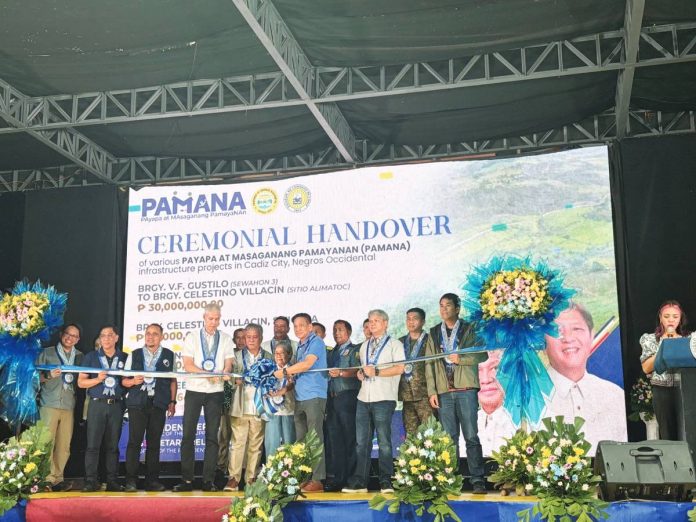
The Office of the Presidential Adviser on Peace, Reconciliation and Unity (OPAPRU), led by Secretary Mel Senen Sarmiento, turned over the projects to the Cadiz City government under Mayor Salvador Escalante Jr. during a ceremony on October 9.
The projects are expected to benefit 73 former members of the Rebolusyonaryong Partido ng Manggagawang Pilipino/Revolutionary Proletarian Army-Alex Boncayao Brigade-Tabara Paduano Group (RPMP/RPA/ABB-TPG), who are now organized under the Kapatiran para sa Progresibong Panlipunan (Kapatiran).
Funded through the national government’s Payapa at Masaganang Pamayanan (PAMANA) program, the projects aim to support the reintegration of former rebels while extending development opportunities to surrounding communities.
The infrastructure package includes three concrete road projects and a multipurpose center intended to improve access to remote settlements, facilitate agricultural transport and provide a venue for community activities.
The road projects consist of a P26-million concrete road connecting Barangay Celestino Villacin proper to Sitio 19A; a P30-million road linking the Sewahon 3 area in Barangay V.F. Gustilo to Sitio Alimatoc in Barangay Celestino Villacin; and a P20-million road from Sitio Tangili to Sitio Huebesan, also in Barangay Celestino Villacin.
The remaining P2.9 million was allocated for the Kapatiran Multi-Purpose Center in Sitio Huebesan.
Escalante said the projects would benefit not only former rebel returnees but also more than 5,000 residents of Barangays Celestino Villacin and V.F. Gustilo.
He thanked President Ferdinand Marcos Jr. and Sarmiento for extending infrastructure assistance to Cadiz City, saying the investments would help advance lasting peace alongside rural and upland development.
The mayor said the city government had started concreting roads in the area during the COVID-19 pandemic but lacked sufficient resources to complete all its planned infrastructure projects.
With OPAPRU’s assistance, the city can address remaining infrastructure gaps and improve access to communities that have long faced difficulties reaching major roads and economic centers.
“While we secure peaceful communities for our former rebel friends, we also introduce rural and upland development for them to thrive through peace and economic opportunities,” Escalante said.
Coffee industry
Beyond improving transportation, the roads are expected to support Cadiz City’s expanding agricultural sector, particularly its developing coffee industry.
The city has allocated around 2,500 hectares of the Nakar Estate in Barangay V.F. Gustilo for its coffee venture, which began about two years ago.
Escalante said approximately 600,000 full-grown coffee trees are currently maintained by around 700 upland and rural farmers from seven barangays: V.F. Gustilo, Jerusalem, Luna, Caduha-an, Magsaysay, Mabini and Celestino Villacin.
The city aims to increase production by planting a total of one million coffee trees over the next eight years. It is also planning to establish a P12-million coffee processing plant in Barangay V.F. Gustilo.
The initiative forms part of the city’s efforts to diversify its agricultural economy and create additional income opportunities for upland farmers.
Cadiz City is also exploring coconut and pineapple production as alternative sources of livelihood.
Escalante said improved roads would make it easier for farmers to transport their harvests to markets, reducing logistical difficulties and enabling rural producers to participate more actively in the local economy.
“The OPAPRU projects are a blessing that will provide farmers with easier access to transport their harvest,” he said.
Better road connectivity is also expected to improve access to government services and economic opportunities for remote communities, including Indigenous Peoples’ settlements.
Escalante cited a recent visit by a major bus company that assessed the possibility of establishing routes connecting Don Salvador Benedicto and San Carlos City. The proposed routes remain subject to further development.
Meanwhile, Negros Occidental Second District Rep. Alfredo Marañon III underscored the need to improve road networks linking upland communities across northern Negros Occidental.
Marañon said he hoped to connect upland areas of Cadiz and Sagay cities and the municipality of Manapla to improve transportation and open up more opportunities for residents and farmers.
Cadiz City is the second local government unit in northern Negros Occidental to have a Kapatiran multipurpose center, following San Carlos City.
The PAMANA program supports development initiatives in conflict-affected and conflict-vulnerable communities through infrastructure and livelihood-related interventions that complement peacebuilding and reintegration efforts.
Also present during the turnover ceremony were Negros Occidental Gov. Eugenio Jose Lacson, Marañon and Lt. Col. Eric Alfonso, commander of the Philippine Army’s 79th Infantry Battalion, among other officials./PN