



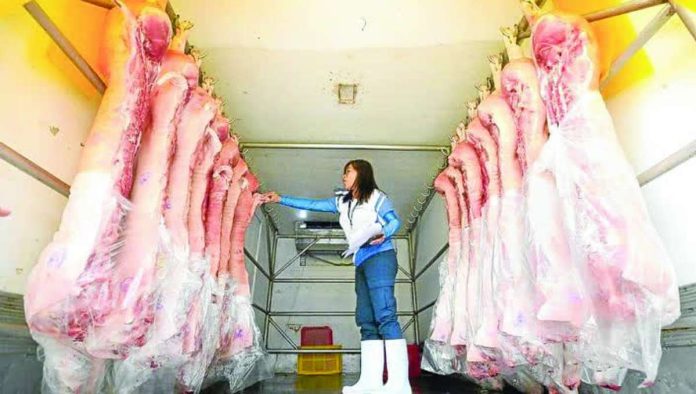
More imported meat entered the Philippine market last month as the country bought more chicken and pork, prompting some local livestock groups to air concerns over a potential oversupply and its adverse impact on domestic producers.
Latest data from the Bureau of Animal Industry showed that the Philippines imported 149.5 million kilograms (kg) of meat in July, up 5.48 percent from 141.73 million kg in the same month last year.
This brought total meat imports in the first seven months of 2026 to 1.02 billion kg, up 11.08 percent from 919.84 million kg in the same period in 2025.
As in previous months, pork still accounted for the bulk of imported meat, with 86.02 million kg entering the country in July, up 6 percent from 81.13 million kg in the same month last year. Pork accounted for 57.54 percent of total inbound meat shipments last month.
With more imported pork entering the Philippine market, groups of local hog raisers have raised the alarm and called on the government to reinstate higher pork tariffs to protect the domestic hog industry.
According to Pork Producers Federation of the Philippines Inc. president Eric Harina, the current combined supply of local and imported pork is already sufficient to meet their estimated 2026 demand of 1.7 million metric tons.
Hog raisers sound alarm
As such, he warned that additional imports could result in a surplus and deal a blow to the Philippine hog industry.
“We cannot afford not to import because we have industries that need special cuts,” Harina told reporters. “But of course, we should only limit the volume based on the demand and the local production. We should balance it so that the local industry won’t be affected.”
Thus, Harina’s group, along with the Philippine Pork Council Alliance Inc. and Agap Partylist, is pushing for the reinstatement of the 30-percent in-quota and 40-percent out-quota tariffs on pork, higher than the prevailing 15-percent in-quota and 25-percent out-quota levies.
They blamed the lower tariffs for what they described as the current “overimportation” of pork, which already reached 541.41 million kg from January to July.
“At this rate, we can expect a total importation of almost 1 billion kilograms of pork at the end of the year,” the groups said. “Should this happen, what will happen to the local hog sector?”
In July, the Philippines imported 44.17 million kg of chicken, making it the second-most imported meat after pork. This amount increased from 36.74 million kg in the same month in 2025, representing 29.55 percent of the total meat imports for that month.
Within this segment, traders primarily purchased mechanically deboned or mechanically separated meat, a raw material commonly used in processed products such as sausages, nuggets and hot dogs.
Unlike pork and chicken, beef imports fell by 23.32 percent in July to 14.8 million kg from 19.3 million kg a year earlier. Beef cuts remained the most imported beef product, with 9.61 million kg purchased during the month, followed by beef fat.
Brazil remained the country’s top source of meat imports, shipping 491.2 million kg to the Philippines from January to July. Of that amount, pork accounted for 257.73 million kg, followed by chicken at 189.4 million kg.
Coming in at No. 2 was the United States, which shipped 127.38 million kg of meat to the Philippines during the seven-month period. (Logan Kal-El M. Zapanta © Philippine Daily Inquirer)