



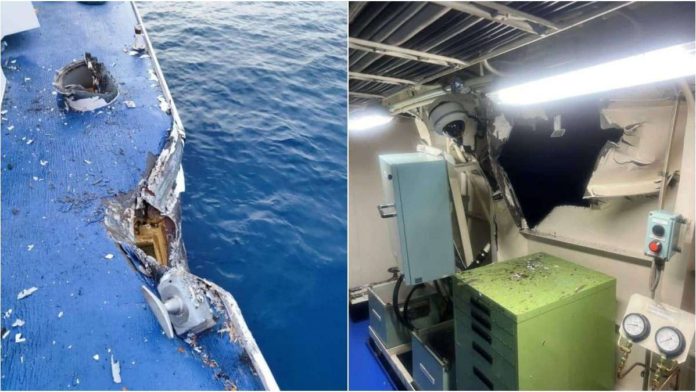
MANILA – The government is considering filing a case against China following the collision incident near Escoda Shoal in the West Philippine Sea (WPS) on early Monday.
National Maritime Council (NMC) spokesperson Alexander Lopez said they will connect with the Philippine Coast Guard to determine what really transpired.
“We are looking at that, especially the part of the Coast Guard kasi they know more,” Lopez said in a media briefing at Malacañang Palace. “Maybe we’ll get back to you as we get more inputs from the Coast Guard.
Lopez added that China should refrain from their aggressive actions and adhere to international law. He added that the latest action of China is concerning for the Philippines.
Presidential Assistant on Maritime Concerns Secretary Andres Centino, for his part, said that upon the creation of the NMC, three new members were added including the Solicitor General, the National Security Adviser, and the National Intelligence Coordinating Agency (NICA) chief.
“That actually signifies the intent of the government to consider perhaps a filing of a case… the Solicitor General is tasked to do these things,” said Centino, who added that the case could be filed before United Nations bodies.
The Philippines has accused the Chinese Coast Guard of performing “unlawful and aggressive maneuvers” in the West Philippine Sea (WPS), which resulted in collisions that damaged two Philippine Coast Guard (PCG) vessels.
China Coast Guard spokesperson Gan Yu, for his part, claimed that Philippine vessels BRP Bagacay and BRP Cape Engaño “deliberately” collided with a CCG vessel near Escoda Shoal.
Philippine authorities said the two vessels were about to deliver essential supplies to personnel stationed in Patag and Lawak Islands when the incident took place.
Escoda or Sabina Shoal is located 75 nautical miles or about 140 kilometers off Palawan and is within the Philippines’ 200-nautical-mile exclusive economic zone (EEZ).
Despite talks for deescalation, tensions continue amid China’s massive claim in the South China Sea, including the portion the Philippines refers to as the WPS.
The SCS is a conduit for more than $3 trillion in annual ship commerce. Aside from the Philippines, China has overlapping claims in the area with Vietnam, Malaysia, Indonesia, and Brunei.
In 2016, an international arbitration tribunal in The Hague ruled in favor of the Philippines over China’s claims in the SCS, saying that it had “no legal basis”, but China does not recognize the decision./PN