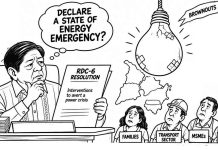



THE VISAYAS has been given an uncomfortable timetable: endure.
Energy Secretary Sharon Garin says recurring yellow and red alerts may begin easing next month, but they will not disappear. The real, long-term solution — additional generating capacity — may not stabilize the electricity supply until 2028.
That means households, businesses, hospitals and industries across Iloilo, Panay and the rest of the Visayas could remain vulnerable to supply shortages and rotational brownouts for another two years.
This electricity problem is obviously a planning problem. And perhaps the most important admission in Garin’s statements is precisely that: government must anticipate the electricity requirements of every region rather than wait until supply becomes inadequate.
Power plants cannot be built overnight. Garin herself pointed out that they normally take about five years to construct, although the Department of Energy is pushing investors to shorten the period to three years. Precisely.
If government knows that electricity infrastructure requires years of planning, financing, permitting and construction, then energy shortages should not be treated merely as emergencies to be confronted after they arrive. Energy planning must stay several steps ahead.
The present shortage is what happens when generating capacity and supporting infrastructure fail to keep pace with demand. Now government is scrambling for stopgap measures.
Battery facilities in Santa Barbara and San Joaquin are expected to provide additional electricity once connected to the grid, while three power barges are being eyed to augment supply to Panay and the Negros Island Region by the end of 2026 or the first quarter of 2027. But emergency measures must never become substitutes for sound energy policy.
A brownout is not merely a darkened light bulb. It can mean interrupted production in a factory, spoiled merchandise in a store, disrupted operations in a hospital, lost hours for workers and businesses, damaged appliances and sleepless nights for families. Garin put the issue succinctly: “the most expensive power is no power at all.”
She is right.
But that truth also imposes a heavier responsibility on government. If having no electricity is extraordinarily expensive, preventing electricity shortages must be treated as an economic and national-security priority. Regulators, grid operator, generation companies and distribution utilities must continuously assess whether supply will be sufficient not only tomorrow or next summer, but five, 10 and 20 years from now.
The public deserves more than appeals for patience whenever yellow and red alerts appear.
It deserves an energy roadmap showing how much additional capacity the Visayas needs, where that capacity will come from, when projects will become operational, whether transmission infrastructure can accommodate them, and what contingencies exist when generating plants unexpectedly go offline.
The present crisis must become the last time the Visayas finds itself desperately searching for barges, batteries and other temporary solutions because permanent capacity did not arrive before demand overtook supply.
The promise of a more stable grid by 2028 offers hope. But 2028 must not simply become another deadline that moves when it arrives. Build the plants. Strengthen the grid. Accelerate legitimate projects without sacrificing safety. Diversify generation. Maintain adequate reserves. Forecast demand realistically. Hold responsible institutions accountable for delays.
Most importantly, plan before scarcity becomes crisis. Electricity shortages are often planted years earlier — when somebody should have seen the darkness coming.