



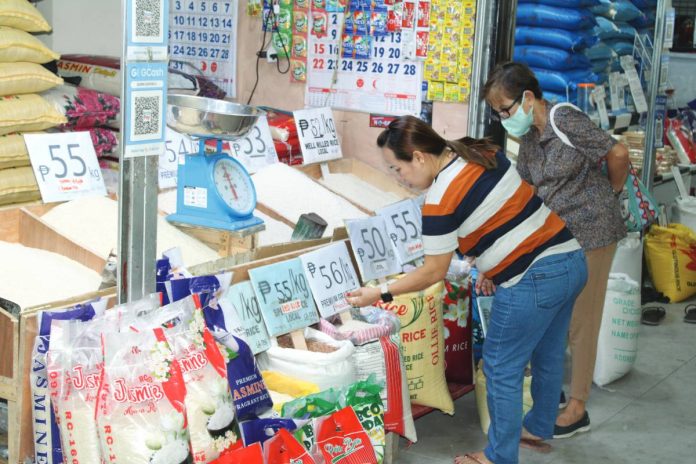
ILOILO City — Rising farmgate prices of palay (unmilled rice), compounded by fuel-driven logistics costs linked to the Middle East crisis, have begun pushing up retail rice prices in Western Visayas, with authorities warning that broader food inflation may follow if global pressures persist.
Monitoring by the Department of Agriculture (DA) Region 6 showed that as of March 18, prices of locally produced rice have started to inch upward, signaling early signs of supply chain pressure despite the region’s strong production base.
Local premium rice climbed to P50 per kilogram from P48 recorded in the second week of March, while local well-milled rice increased to P46.50 per kilogram from P46.
“The price of imported premium rice has remained stable compared to last week, with no noticeable changes, as of today. Similarly, the cost of local produced regular milled rice has held steady over the same period. However, a slight increase has been observed in the prices of both local premium rice and local will-milled rice,” the DA-6 said.
DA-6 Regional Technical Director for Operations and Extension Maria Teresa Solis attributed the increase primarily to higher palay buying prices, now ranging from P20 to P23 per kilogram for wet palay and P26 to P28 per kilogram for dry.
“Taas na ang buying price sang palay so mataas naman ang hatag sang suppliers sa ila rice retailers,” Solis said.
She added that rising fuel prices have further strained the supply chain, especially for retailers relying on transport logistics.
As of March 18, DA-6 monitoring showed the following retail prices:
* Imported Premium Rice – P60
* Local Premium Rice – P50 (P48 last second week of March)
* Local Well-Milled Rice – P46.50 (P46 last second week of March)
* Local Regular-Milled Rice – P42
Despite these increases, imported rice prices remained unchanged due to the absence of new stock arrivals, with existing supply consisting mostly of older inventories.
Solis emphasized that only President Ferdinand “Bongbong” Marcos Jr. has the authority to impose a Suggested Retail Price (SRP) on rice, limiting the DA’s capacity to directly regulate prices at the regional level.
However, she warned retailers against excessive price hikes, noting that violators may face regulatory action.
“Ang DA or DTI (Department of Trade and Industry) naga-send sang show cause order sa retailers. Pero indi na sila kapagusto sang saka sang presyo kay naganubo ang quality sang rice kon dugay na nga stock,” she added.
Solis assured the public that rice supply remains sufficient in the region, which currently stands at 120 percent rice sufficiency and ranks fourth nationwide in production.
At the national level, the DA has recommended imposing a price cap on imported rice, amid reports of retail prices reaching up to P60 per kilogram in some areas.
Agriculture Secretary Francisco Tiu-Laurel warned that some retailers are selling imported rice at P55 to P58 per kilogram when prices should only range from P45 to P48.
“Reasonable naman ‘yung kaunting taas but what we are seeing here is hindi reasonable ‘yung pagtaas ng imported rice dahil ang cost niyan mababa pa today,” he said.
“The price of imported rice should not go beyond P50,” Tiu-Laurel added.
“Definitely, may nananamantala. That’s why…nagrekomenda kami na mag-impose ng price cap on imported rice. Pinag-aaralan pa ‘yan ng legal,” he said.
Malacañang has yet to approve the proposal, as it remains under review by several government bodies.
“So sa ngayon market intervention ang ginagawa natin and we are making P48 and P45 rice available,” he said. “Sa ngayon nasa 36 markets siya in Metro Manila and we are expanding that pa, in Metro Cebu muna.”
The DA clarified that any price cap will not apply to locally produced rice to ensure better earnings for Filipino farmers during the harvest season.
Authorities also warned that prices of other agricultural commodities could rise by as much as P2 per kilogram if fuel costs continue to escalate.
Just last week, DA-6 warned retailers and wholesalers not to exploit the surge in fuel prices as a justification to arbitrarily raise the prices of agricultural and fishery products, stressing that supply remains stable and price manipulation will be closely monitored.
“Gina-request ang retailers nga indi pagtam-an or grab opportunity nga i-rason nila ang taas nga gasolina subong. So, buligay lang ta para makalampuwas ta sa sitwasyon subong,” Solis told Panay News.
Despite rising fuel costs, Solis assured the public that Western Visayas currently has sufficient supply of agri-fishery products.
She noted that local produce from municipalities such as Leon and Tubungan in Iloilo province continues to supply markets, while additional shipments arrive regularly from other producing areas such as Baguio, Cagayan de Oro, Bukidnon, and other parts of Mindanao.
Solis warned that unjustified price increases could backfire on traders.
“Kon pasakaan sang retailers and wholesalers ang ila baligya, indi man magbakal ang consumers. Maapektohan man ang ila income,” she said.
DA-6 also assured the public that there is no reason to panic about rice supply, noting that Western Visayas maintains more than 100 percent rice sufficiency and that the harvest season is approaching./PN