


ILOILO City – Is Western Visayas ready for a major earthquake?
The Office of Civil Defense (OCD) urging local government units (LGUs) to conduct assessments or inspections of buildings, especially older ones, to ensure they are structurally sound and safe.
While LGUs and government agencies in the region are equipped in terms of response mechanisms due to regular earthquake drills, the OCD is worried about the structural integrity of structures.
According to Maria Cristina Mayor, spokesperson for OCD Region 6, confidence in the structural integrity of buildings in highly-urbanized cities like Iloilo City and Bacolod City is high, but the situation in other areas remains uncertain.
Not all have been thoroughly inspected, she said.
“We need to implement policies that promote sound engineering practices,” stressed Mayor, because “preparedness should not only be reactive but proactive.”
While Western Visayas is “prepared for the big one in terms of response mechanisms, when it comes to our infrastructure, that is where we might fail,” she warned.
Building assessment is within the purview of the engineering department of every LGU with technical assistance from the Department of Public Works and Highways.
It is unclear if LGUs are actively checking buildings and other infrastructure within their jurisdictions in the context of possible earthquakes.
The region is no stranger to strong tremors. Panay Island has an active West Panay Fault Line.
In Jan. 25, 1948 around 1:46 a.m. a magnitude 7.8 tremor jolted Panay Island and its sleeping people. It destroyed 55 Spanish-era stone churches and triggered a tsunami.
This 1948 quake called “Lady Caycay” is still considered one of the biggest earthquakes in the 500-year Philippine earthquake history. The epicenter was reported to be between Antique’s towns of Tobias Fornier (called Dao at that time) and Anini-y.
The quaking went on for some three minutes, followed by a series of aftershocks which people then said they felt until 5:52 a.m.
Of the 55 damaged Panay churches, 17 totally collapsed, archives showed. These included the churches in Igbaras, San Miguel, Oton and Maasin, all in Iloilo province.
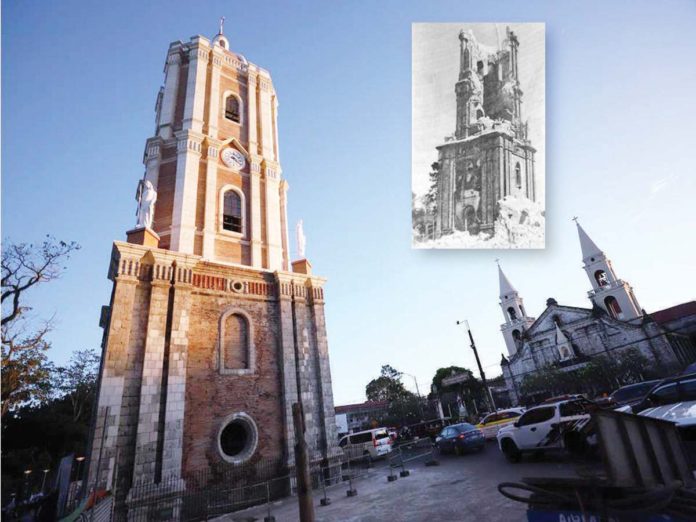
Belfries or church bell towers of San Joaquin, Alimodian, Tigbauan, Dueñas, Dumangas, Guimbal, Lambunao and the Iloilo City district churches in Jaro, Molo and Arevalo were also damaged.
The most prominent of these destroyed belfries was that of the Jaro Cathedral. Made of limestone and bricks, its second and third storeys crumbled, and was completely restored only in 2022.
The “Lady Caycay” earthquake also severely damaged the historic church and convent of the town of Santa Barbara, Iloilo.
DRILLS
To ensure disaster resilience and readiness for potential earthquakes, all LGUs in Western Visayas are required to conduct earthquake and evacuation drills, among other exercises.
“So far, almost all LGUs in the region have complied with conducting quarterly earthquake drills, as mandated by the Department of Interior and Local Government (DILG),” Mayor told Panay News.
In cases where LGUs are unable to conduct their own drills, some partner with government offices such as the Bureau of Fire Protection (BFP), Philippine National Police (PNP), or schools to practice the “duck, cover, and hold” technique, she said.
This second quarter of the year, Bacolod City in Negros Occidental was the pilot site for the Nationwide Simultaneous Earthquake Drill (NSED), coordinated by OCD-6. The drill simulated four distinct earthquake scenarios in key impact areas of the city including La Consolacion College Bacolod, Park Inn by Radisson Bacolod, Rizal Elementary School, and Purok Violeta in Barangay Taculing.
Participants ranged from local government units to educational institutions, private businesses, and community organizations, all evaluated by experts in the Incident Command System during the post-activity evaluation.
OCD-6 director Raul Fernandez commended the collaborative efforts, syating, “The successful execution of the drill underscores our commitment to disaster resilience. It is through these collaborative efforts that we can effectively mitigate the impacts of natural disasters and protect our communities.”
The NSED is part of a national initiative to enhance disaster preparedness and resilience across the Philippines. Mayor emphasized the importance of conducting these drills to ensure LGUs are well-prepared to act as frontliners in response to community needs during disasters.
While there is no legal liability for LGUs that fail to conduct earthquake drills, those aiming for the Seal of Good Local Governance (SGLG) Award from DILG must pass the Disaster Risk Reduction and Management (DRRM) component, which includes conducting earthquake drills. The OCD-6 also bases its Gawad Kalasag Award for LGUs on the conduct of such drills.
In addition, OCD-6 encourages not just earthquake but also fire and evacuation drills, especially given the increase in fires during the first six months of this year due to the El Niño phenomenon.
The onset of the rainy season also brings concerns about floods and landslides, prompting OCD-6 to promote enhanced response capabilities and responsible farming practices to prevent environmental degradation, particularly in northern Iloilo./PN