

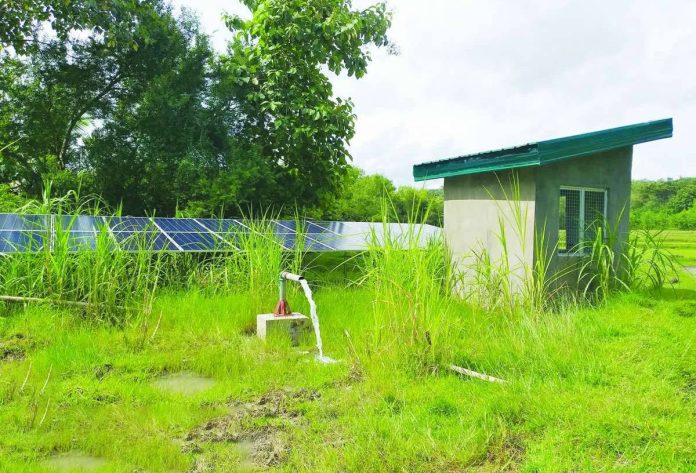
ILOILO — The National Irrigation Administration (NIA) is rapidly expanding its solar-powered irrigation program (SPIP) in Western Visayas, deploying 141 operational units across the region to shield farmers from intensifying climate risks and soaring fuel costs while boosting agricultural productivity.
The aggressive rollout comes as authorities brace for extreme heat conditions and the looming threat of El Niño, which continue to strain water resources and farm output.
NIA regional manager Engineer Jonel Borres underscored the agency’s shift toward science-based irrigation systems designed to ensure stable water supply despite unpredictable weather patterns.
“Our operational SPIP units are strategically installed across various provinces – Capiz, Aklan, Antique, Iloilo and even Negros Occidental. These units harness solar energy to provide much-needed irrigation water, making a substantial difference for farmers,” Borres said.

He revealed that reservoir levels in Western Visayas are nearing critical thresholds and forecasts pointing to a looming El Niño phenomenon, thus NIA Region 6 has intensified measures to protect agricultural water supply and shield farmers from an impending dry spell that could disrupt the next planting season.
NIA-6 revealed that water reserves have dropped to just 135 million cubic meters out of a 250-million capacity, raising concerns over irrigation sustainability if extreme heat persists.
The SPIP has already benefited more than 750 farmers and irrigated 2,534 hectares of farmland across Western Visayas as of October 2025, according to NIA-6.
The projects are distributed as follows: 54 in Aklan and Capiz, 63 in Iloilo and Guimaras, 11 in Negros Occidental, and 13 in Antique.
Borres highlighted that the solar-powered systems eliminate dependence on expensive fuel, a critical advantage for farmers grappling with rising diesel and gasoline prices.
“At this time, with soaring diesel and fuel prices, our solar pump initiative stands as a beacon of sustainability. Since solar pumps operate on renewable energy, farmers can irrigate their lands without incurring fuel costs, which is especially critical in regions where resources are strained,” he said.
Borres further stressed the importance of the technology amid prolonged dry conditions.
“Sa subong nga panahon, tam-an ka init kag tama ka taas ang fuel, diesel, and gas. Pero wala man ‘ni siya epekto sa aton sa solar pump project. Kay solar, wala kita gasto sa fuel. Deretso ang renewable energy para mapa-andar ang pump. Makapatubig kita sa mga talamnan. Dako ang pagpasalamat sang aton farmers, especially sa areas nga may bastante nga tubig nga source para sa aton nga solar water pumps,” Borres added.
NIA-6 is further ramping up the initiative, with 78 additional SPIP projects underway that are expected to serve 938 more farmers and irrigate another 1,350 hectares.
The agency said site selection for solar pump installations follows strict technical evaluation, prioritizing areas with reliable water sources such as groundwater, reservoirs, and surface water.
“Our selection criteria for solar pump installation is meticulous and grounded in practicality. We prioritize areas with plentiful water sources — these can include groundwater, open reservoirs, or surface water — to ensure that our farmers can access the irrigation they need,” Borres explained.
“Before any project is initiated, thorough evaluations and site assessments are conducted to identify the most suitable locations,” he said.
NIA has committed P2.248 billion for both operational and ongoing SPIP projects, signaling a long-term investment in climate-resilient agriculture.
Officials said the program is part of a broader push to modernize irrigation systems, strengthen food security, and equip farmers with sustainable tools to cope with increasingly volatile climate conditions./PN