



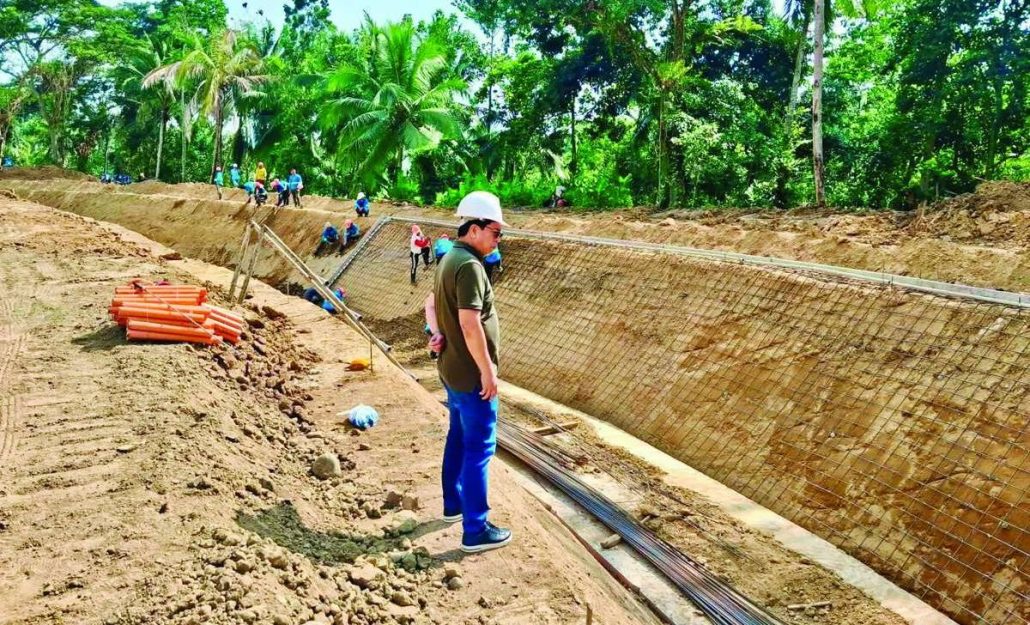

ILOILO — The looming super El Niño will put Iloilo’s P25.66-billion Jalaur River Multi-Purpose Project Stage II (JRMP II) to its biggest test yet, as the partially operational project demonstrates whether its massive water reserves can keep thousands of hectares of farmland productive through a prolonged dry spell.
The National Irrigation Administration (NIA) Region 6 said the mega dam is already emerging as a crucial defense for Iloilo agriculture from prolonged dry conditions forecast from October until the first quarter of 2027, providing irrigation to more than 500 hectares of farmland in Calinog town and allowing additional water to be released for around 10,000 hectares downstream.
Following the completion of portions of the High Line Canal (HLC) and main and lateral canals under Zone 1 of JRMP II, about 500 hectares in the Calinog barangays of Badu, Aglibacao, Lonoy and Alibunan are already receiving irrigation water, NIA-6 spokesperson Steve Cordero told Panay News.
The benefits have already gone beyond simply maintaining rice production.
Cordero said around 50 hectares in the four barangays successfully undertook a third cropping this year — referred to by NIA as “double dry” cropping — because of the continuous availability of irrigation water.
“Amo ina nga sige man ang pagtanum sang aton farmers,” Cordero said.
JRMP II has also tested the release of water from its reservoir into the Jalaur River toward the Moroboro Dam in Dingle town, providing NIA with another mechanism to sustain irrigation in downstream agricultural areas.
Cordero said the system could augment water supplies for around 10,000 hectares of farmland in Dingle, Pototan and Barotac Nuevo.
“Amo ‘ni subong ang duha ka pamaagi kon sa diin ang aton JRMP II Project, though indi pa fully completed and fully operational, Cordero said.
The project’s role could become even more critical once the anticipated El Niño intensifies and threatens water supplies and agricultural production across Iloilo.
JRMP II’s reservoir has a capacity of 250 million cubic meters. It currently holds about 112 million cubic meters of water.
El Niño is a recurring climate pattern characterized by unusually warm sea-surface temperatures in the central and eastern equatorial Pacific Ocean. The phenomenon disrupts normal atmospheric circulation and rainfall patterns and, in the Philippines, generally increases the likelihood of below-normal rainfall, dry spells and drought in affected areas.
A “Super El Niño” is a popular term for an exceptionally intense or very strong El Niño, when warming in the tropical Pacific becomes particularly pronounced. Such can produce stronger disruptions in rainfall and temperature patterns, although their exact effects vary by location.
Cordero said the JRMP II was designed precisely to capture water during the rainy season and store it for release when dry conditions set in.
“Indi kita magkahangawa nga ma-completely dry up, nga wala na gid sang tubig. Ang purpose ni JRMP II is rain collecting during rainy season. Ma-collect ang tubig and once mapuno, i-release naton during the dry season,” he said.
Once JRMP II becomes fully operational, Cordero said Iloilo would be in a much stronger position to withstand future El Niño episodes and prolonged dry spells.
As of August 2026, the project was reported at 87.64 percent completion, with remaining works concentrated on the HLC and the main and lateral canal systems.
Of the 80.736-kilometer HLC, almost 50 percent has been completed, while more than half of the nearly 160 kilometers of main and lateral canals has been finished.
“On schedule kita for completion by 2027, initial target naton completed tanan nga facilities by June 2027 and maka-operate kita by end of December 2027 or early first quarter sang 2028,” Cordero said.
Western Visayas is bracing for a prolonged six-month dry period beginning this October, with a very strong El Niño threatening to trigger water shortages, drought, extreme heat and mounting pressure on agriculture and power supply through March 2027.
The Philippine Atmospheric, Geophysical and Astronomical Services Administration (PAGASA) warned that rainfall across the region is expected to fall below normal in October and November before deteriorating to way-below-normal levels from December 2026 to March 2027.
Engr. Ferdinand L. Rubin Jr., weather specialist at PAGASA-Iloilo, said during a scientific forum in Iloilo City that the prolonged rainfall deficit could set off interconnected problems affecting water, food production and energy as temperatures rise.
“Water crisis is very possible. Kun kulang ang ulan. Wala clouds, so there are hotter temperatures, of course there will also a crisis sa heat,” Rubin said, adding that increased use of air-conditioning units could further strain the energy sector.
“Cascaded ‘yan. Interrelated ang mga problema sa heat,” he added.
PAGASA’s rainfall outlook indicates that drought conditions could develop across the country from January to March 2027, while Iloilo Province and Iloilo City could experience dry spell and drought conditions toward the end of the first quarter./PN