
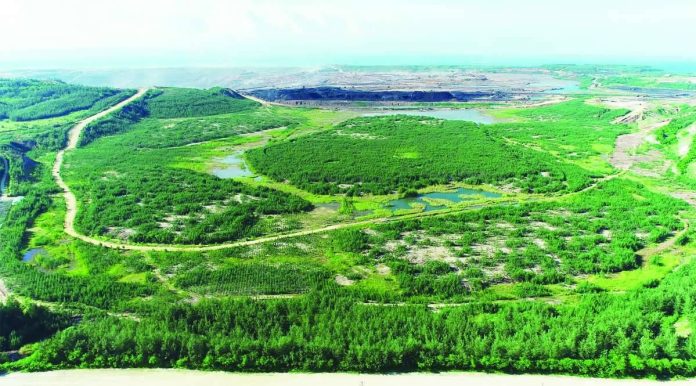
ON SEMIRARA Island, the landscape tells a story that is still being written.
For decades, the island’s story has been closely tied to coal. Declared a coal mining reservation in 1940 under Proclamation No. 649, Semirara was later designated as a coal region under Presidential Decree No. 972, or the Coal Development Act of 1976. Now, it is home to the country’s largest known coal reserve and operating coal mine under Semirara Mining and Power Corporation’s (SMPC) Coal Operating Contract.
But look closer at the island today, and another story emerges—one of rehabilitation, regeneration, and the return of life.
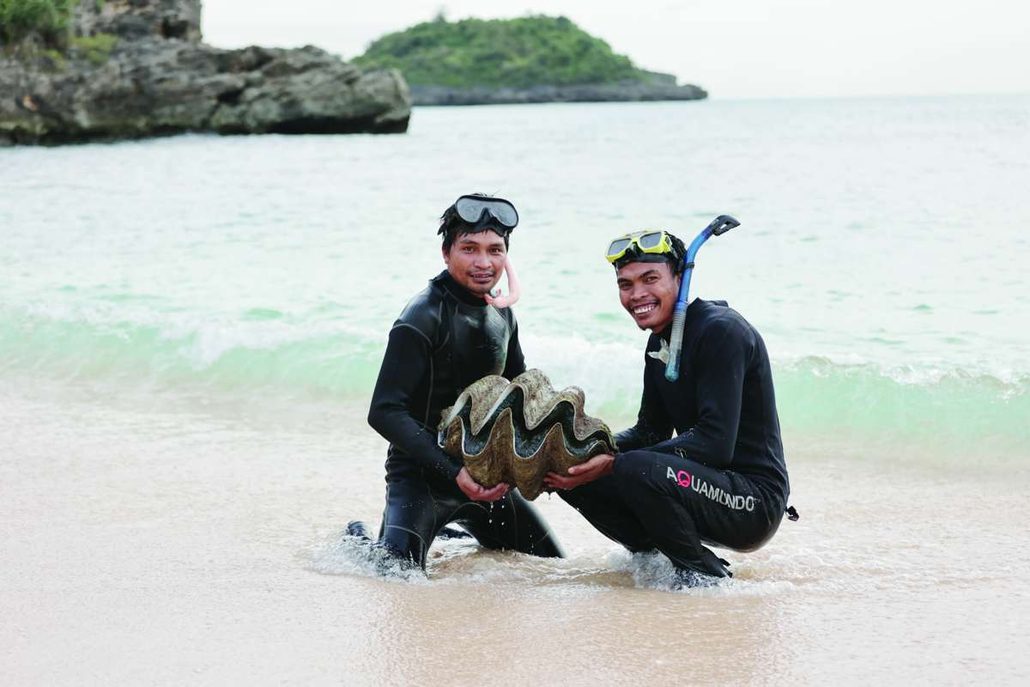
Across former mine sites, forests are taking root. Birds have found new habitats. Mangroves line portions of the coast. Beneath the surrounding waters, giant clams are being propagated and returned to the sea. What was once a landscape shaped primarily by extraction is increasingly becoming a landscape where restoration and conservation have a place alongside mining.
For SMPC, environmental stewardship begins with a simple premise: mining leaves a footprint, and that footprint must be responsibly managed.
The company approaches environmental management through a science-based framework focused on avoiding impacts where possible, reducing those that cannot be avoided, and transforming areas affected by mining into productive and sustainable landscapes.
The results can be seen in the scale of rehabilitation already undertaken across Semirara.
As of June 2026, SMPC has rehabilitated and reforested 744 hectares of mined-out areas, while another 597 hectares outside the mine area have been reforested. More than 3.3 million trees have been planted, including approximately 984,000 trees outside the mining area. Along the coast, 161 hectares of mangrove areas have been reforested, with 634,000 mangroves planted on Semirara Island.
From open pit to living landscape
One of Semirara’s most striking examples of mine rehabilitation is the former Panian mine.
When the Panian pit closed in 2016, rehabilitation presented an enormous engineering and environmental challenge. The former open pit extended to approximately 260 meters below sea level. Transforming such a massive mine into a stable and productive landscape required moving an extraordinary volume of material.
SMPC completed the backfilling of the Panian mine in 2022, covering the pit in six years through approximately 11.5 million man-hours of work, well ahead of the original 10-year rehabilitation plan.
The scale is difficult to visualize: approximately 452 million bank cubic meters of material were used for backfilling, equivalent to around 217,000 Olympic-sized swimming pools.
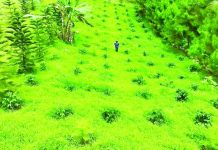
The physical transformation was equally dramatic. The former mine landscape was reshaped from 260 meters below sea level into rolling terrain reaching approximately 5 to 11 meters above sea level. Across the rehabilitated area, more than 400,000 endemic and native tree seedlings were planted.
Today, South Panian is no longer simply a former mine site.
It has become a developing biodiversity hub, with more than 401,260 surviving trees and an expanding population of birds and other wildlife.
The rehabilitation of South Panian was recognized with an ASEAN Energy Award in 2021, reflecting the significance of the accelerated restoration effort.
The achievement also illustrates an important principle behind progressive mine rehabilitation: restoration does not have to wait until the very end of mining. Areas that have already been mined out can be progressively backfilled, stabilized, planted, and prepared for their next use.
In this way, rehabilitation becomes part of the life of the mine, not merely something that happens after mining ends.
When a mining island becomes a bird refuge
Perhaps one of the more unexpected chapters in Semirara’s environmental story can be found in the sky.
Since 2018, the Semirara Biodiversity Conservation Center (SBCC)—known locally as the Aviary—has served as a center for wildlife rehabilitation and terrestrial biodiversity conservation.
The facility cares for vulnerable wildlife from Mindoro and Western Visayas, while also serving as a venue for educational tours and environmental awareness activities. Its work is supported by collaboration with scientific experts, environmental consultants, and national and local government agencies.
As of June 2026, the SBCC had cared for 375 birds, 116 reptiles, and 10 mammals, with more than 150 progenies born under its care.
But the story extends beyond the animals housed at the center.
Seasonal biodiversity assessments conducted with third-party consultants have documented a surprisingly rich avian community across Semirara. The evolving landscape has created a collection of microhabitats that support an expanding variety of bird species.
Semirara is now home to 12 endemic bird species, including the Plain Bush-Hen, Philippine Eagle-Owl, Philippine Hawk-Cuckoo, and Philippine Duck. Another 67 migratory species have been observed using the island as a stopover, including the Great Egret, Ruddy Kingfisher, and Northern Boobook.
It is an unexpected picture: an island best known for coal becoming a temporary home, feeding ground, or refuge for birds traveling across the region.
The forest beyond the mine
SMPC’s biodiversity efforts extend beyond areas directly affected by mining.
Its approach follows three principles: Prevent, Reduce, and Transform.
Prevention means identifying ways to proactively protect habitats and biodiversity through programs such as those of the SBCC and the Semirara Marine Hatchery and Laboratory (SMHL).
Reduction includes progressive rehabilitation—backfilling mined-out areas, stabilizing soil, planting trees, and controlling erosion to reduce the environmental and safety risks associated with disturbed land.
Transformation goes a step further.
It asks what a mined-out landscape can become.
For SMPC, restoration is intended to create productive and sustainable uses that can benefit both the environment and communities. Across Semirara Island, the company reports 1,751 hectares of habitats restored and protected as of June 2026.
The philosophy is straightforward: a rehabilitated mine should have a future beyond mining.
A nursery beneath the sea
Semirara’s environmental story does not end where the shoreline begins.
Established in 2010, the Semirara Marine Hatchery and Laboratory (SMHL) has become a key part of the island’s marine conservation work, focusing on coral reef rehabilitation and giant clam propagation.
The facility is currently the only privately managed facility in the Philippines dedicated to giant clam breeding, propagation, and coral reef rehabilitation.
Of the 12 known giant clam species, eight are propagated at SMHL. Among them is Tridacna gigas, the true giant clam, a critically endangered species.
These animals are more than spectacular inhabitants of tropical seas. Giant clams also function as bio-indicators, offering clues about the health of the marine ecosystem in which they live.
As of June 2026, 82,000 giant clams had been reseeded in Semirara’s waters.
SMPC has also restored and protected 288 hectares of marine habitats and deployed 40 artificial reef balls to support marine life.
In a sense, the work at SMHL mirrors the rehabilitation happening on land. The objective is to help damaged or vulnerable ecosystems recover their capacity to support life.
Measuring what cannot always be seen
Environmental management also depends on resources that are less visible than forests or wildlife.
Water, for example, is essential to an island operation. SMPC sources water from freshwater bodies such as rivers, springs, and groundwater, supplemented by desalination plants, rainwater collection systems, and impounded sources including South Panian and Sanglay Lake.
Water resources are regularly monitored and tested to assess their condition and the effectiveness of management measures.
Energy use is another part of the environmental equation. In 2025, SMPC saved 12.25 GWh by sourcing electricity from wind turbines as an offtaker to supplement the energy requirements of its mining operations.
These measures reflect the broader effort to manage the environmental footprint of an operation that exists within a finite island ecosystem.
The landscape after coal
There is an inherent tension in Semirara.
The island’s economic history is inseparable from coal, yet its environmental future depends on what happens to the land, water, forests, and wildlife that remain.
SMPC’s rehabilitation and conservation programs attempt to address that tension by looking beyond the immediate footprint of extraction.
A former pit can become a rolling landscape.
A planted seedling can become part of a forest.
A rescued bird can return to the wild.
A giant clam bred in a laboratory can eventually find its place on the seafloor.
And a coastline cleaned can remain a shared space for the community.
None of these transformations happen overnight. They require engineering, ecological knowledge, monitoring, investment, and the participation of people who live and work on the island.
But over time, the landscape begins to reveal the cumulative effect.
The story of Semirara is therefore no longer written solely in the language of coal reserves, production, and mine life. It is also being written in hectares reforested, trees surviving, birds returning, mangroves taking root, coral habitats restored, and giant clams finding their way back into the sea.
The mine has shaped Semirara’s landscape for generations. Now, through progressive rehabilitation and conservation, the landscape is being prepared for a life beyond the mine.
And perhaps that is the most enduring measure of responsible mining: how much life can remain—and return—when the work is done./PN