

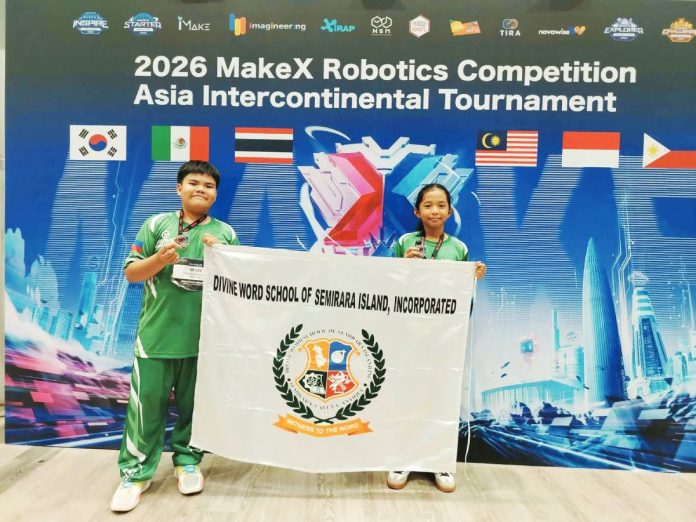
ON OCTOBER 4, two Filipino students stood among the winners of an international robotics competition in Thailand. Their achievement might bring to mind students from well-funded schools in major cities, where advanced technology and specialized training are readily accessible. But these young achievers came from somewhere less expected: the island community of Semirara, where opportunities for quality education have allowed local talent to flourish.
Students Mark Jacob O. Antonio and Gwen Astrid C. Lozada each won a silver award at the 2026 MakeX Robotics Competition – Asia Intercontinental Tournament in Bangkok, Thailand. Both are products of Divine Word School of Semirara Island, Inc. (DWSSII), and their achievement brought pride to their families, their school, and the Philippines.
Their success demonstrates what young people can achieve when they are given access to quality education, supportive learning environments, and opportunities to explore their potential. It also challenges the notion that exceptional talent can only emerge from the country’s major urban and technology centers.
Building opportunities through education
Semirara Island may be better known for its coal industry than for its schools. Yet, within its classrooms, students are developing skills that can take them well beyond the shores of their home island.
This educational environment did not develop overnight. In 2003, Semirara Mining and Power Corporation (SMPC) established DWSSII as part of the broader social and economic development that followed the company’s management of the island’s coal industry.
One of the first schools on Semirara to offer a continuous educational pathway from elementary to college, DWSSII has helped expand access to formal education for generations of island residents. Through SMPC’s support, children of employees and eligible community residents can avail themselves of scholarships, making quality education more accessible to families.
The school also complements its academic programs with facilities designed to broaden students’ learning experiences. These include an expansive library, a radio room, and an AI learning classroom equipped with virtual reality (VR) headsets and touchscreen monitors, allowing students to engage with lessons through more interactive and technology-driven approaches.
The school’s impact can be measured in the generations of students who have passed through its classrooms. Since its establishment, DWSSII has produced more than 5,700 graduates. It currently has another 1,372 students enrolled for the academic year.
Learning beyond the classroom
Access to education does not end with elementary and secondary schooling. Recognizing the importance of providing opportunities for further learning, DWSSII expanded its offerings in 2024 through its Tertiary Education Program.
The program opened another pathway for Semirara residents to pursue higher education. As one of the first institutions on the island to offer bachelor’s degree programs, DWSSII is helping make college education more accessible to students who might otherwise face the additional challenges of studying elsewhere.
Currently, the program has 196 students enrolled.
For those interested in technical and vocational education, another avenue is available through Semirara Training Center, Inc. (STCI), a TESDA-accredited Training and Assessment Center also established by SMPC.
Through its partnership with DWSSII, STCI provides avenues for graduates of the school’s vocational track to continue developing their skills. It also accommodates other island residents and SMPC employees seeking technical training and additional qualifications.
In 2026 alone, STCI produced 122 graduates, bringing its total number of graduates to more than 2,000 since it began operations in 2006.
Education also remains accessible to those whose circumstances have taken them away from the traditional school system. DWSSII hosts the Balik Eskwela Program, the Department of Education’s Alternative Learning System, which allows out-of-school youth and SMPC employees to complete their secondary education. Classes are held on weekends, using the school’s existing classrooms and facilities.
Since 2020, the program has helped 187 beneficiaries complete their secondary education, giving them another opportunity to pursue further studies or improve their prospects for employment.
Taken together, these initiatives provide island residents with multiple pathways to learning, from basic education and college to technical training and alternative learning. They reflect an educational ecosystem that serves not only school-age children but also adults seeking to continue their education and develop new skills.
Protecting the future of island talent
Mark and Gwen’s achievement in Thailand is a testament to what sustained investment in education can make possible. Their journey from a classroom in Semirara to an international competition shows that students from small and geographically isolated communities can excel alongside their peers from anywhere in the world when given the right support and resources.
But the educational system that makes these achievements possible also depends on the stability of the community around it.
Semirara’s economy and the livelihoods of its residents remain closely connected to its coal industry. As uncertainty surrounds the continuity of mining operations, workers have begun seeking employment elsewhere, while the prospect of relocation has become an increasingly real concern for families on the island.
For students, the consequences extend beyond the prospect of moving to another home. Relocation can mean leaving behind teachers, classmates, and support systems built over years. For schools, the departure of families can translate into declining enrollment, adding pressure on institutions and teachers.
Mark and Gwen are among the many examples of what the island’s educational investments have helped cultivate. Their success represents the possibilities that have emerged as Semirara developed into a more established community.
In just a few decades, the island has undergone a significant transformation. What was once a remote community has developed an educational environment where children can pursue their studies from elementary school to college, explore emerging technologies, and acquire skills for future careers.
That progress deserves to be sustained.
Yet, as uncertainty looms over the island’s future, so does the question of whether future generations of Semirara students will continue to enjoy the same educational opportunities. In the months ahead, these children may also have to wonder how much longer they can call Semirara home./PN