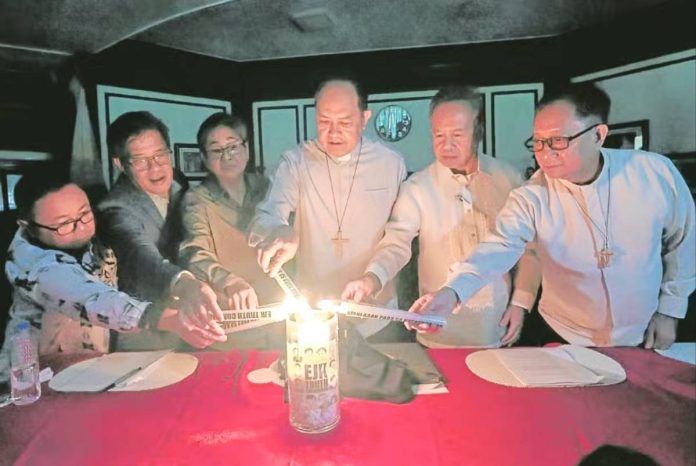
MANILA — An independent “EJK Truth Commission” backed by Church and civil society leaders was formally launched on Wednesday to document the killings and other atrocities linked to the bloody war on drugs waged by former President Rodrigo Duterte.
The body was formed about a decade since the first “extrajudicial killings (EJK)” attributed to the crackdown were recorded in the second half of 2016, or during the first few months of Duterte’s term, and with the 81-year-old ex-president now facing trial for the death of thousands before the International Criminal Court (ICC).
It hopes to gather not only painful accounts of loss but also evidence that can be used to prosecute law enforcers who were directly involved in the brutal crackdown but had not been thoroughly investigated, according to human rights groups.
“This is long overdue,” Cardinal Pablo Virgilio David said during the launch held at the Archbishop’s Palace in Mandaluyong City.
The nongovernment body he helped organize will focus on helping victims, their families and even repentant law enforcers to finally find closure, David said.
“This is an opportunity for a catharsis … so we can recover our dignity as a country,” David said. “Ultimately, what we aspire for is healing not only for the victims but also our institutions.”
‘Conspiracy of silence’
The commission chair, former ICC judge Raul Pangalangan, said the “goal is to hear the victims tell their stories, to recognize their fundamental humanity and what they went through.”
“I would like to emphasize that, for the ICC, the end of the process is of course either the acquittal of the accused or a declaration of guilt, and eventually reparations for the victims,” said Pangalangan, who served as judge in The Hague-based tribunal from 2015 to 2021.
“For us, however, our goal is to establish the truth hand in hand with the victims,” said Pangalangan, who was also a former dean of the University of the Philipppines College of Law and a former Inquirer publisher.
“These things happened because everybody looked the other way,” Pangalangan said. “It is almost a conspiracy of silence.”
David, who will serve as adviser to the commission, added: “The truth must be protected not only as a matter of record, but as a matter of dignity for the families who have carried these stories for years.’’
“The EJK Truth Commission exists so these stories can be heard, verified, preserved and acted upon,” David added.
How many died?
Dr. Raquel Fortun, who will serve as the commissioner for forensic sciences and independent investigation, said her work would seek to address the continuing lack of documentation and autopsy records of the EJK victims.
“I’m looking at the opportunity to search for them because I bet our cemeteries have areas where these unclaimed and unidentified remains were just dumped,” said Fortun, who had conducted numerous exhumations and autopsies for the victims’ families.
Human rights journalist and researcher Carlos Conde will serve as the commissioner for public documentation, transparency, and democratic accountability.
“One of the challenges that we’re facing here is that nobody really knows exactly how many have died. We have different figures. They (human rights watchdogs) say 30,000, the UN says 18,000, the government says 6,000; 7,000,” Conde said.
The commission will work with other nongovernment organizations and possibly with quantitative analysts and researchers on this area of concern, he said.
“We hope to include it in the final report if we can determine accurate figures,” Conde told the Inquirer.
Also on the commission are Dr. Al Fuertes, who will be in charge of survivor protection measures, psychosocial protocols, and recovery support for the victims’ families; and Fr. Daniel Franklin Pilario, who will oversee truth literacy initiatives, prevention programs, public education, and institutional reform recommendations.
Hearings, reports
Central to the commission’s work will be the conduct of “Public Truth Hearings” which may be held publicly or privately in consideration of the families’ security.
The commission will also prepare “evidence-based recommendations and referral-ready packages” for concerned government agencies such as the Commission on Human Rights, the National Police Commission (Napolcom), the Department of Justice, the National Bureau of Investigation, and other authorized bodies.
It is expected to produce periodic reports of its findings and recommendations every six months to institutions such as the Napolcom, Congress, and the Office of the President.
The government may use the reports to help authorities investigate, prosecute and seek accountability, the commission members said.
Questions from a group
One organization representing the families of drug war victims said it would like to know more about the commission.
In a statement issued shortly after the launch, the group Rise Up for Life and for Rights said it plans to hold dialogue with the newly formed commission to better understand its plans and direction.
“What is their framework of ‘reconciliation’? There is plenty that we still need to know, but will they be able to unmask it? Our focus is on the International Criminal Court,” said Llore Pasco, a mother who lost two sons Crisanto and Juan Carlos, to the drug war.
According to Pasco, her group pushed for “victim representation” on the commission and for its composition to be at least 50-percent women.
“We have high regard for some of the civil-society leaders named for the panel. We appreciate that they want to help. We all want the truth to come out. Most of the truth that we need is with the police and other witnesses. Will this body be able to surface such truth?” the statement quoted Pasco as saying.
“Right now our focus is on the trial at the ICC. Here in the Philippines, President Marcos should be helping us in seeking justice, but we must remember that any ‘Truth Commission’ should include killings under his administration too,” said Jane Lee, whose husband Michael was among those killed. (Andrea Gregorio © Philippine Daily Inquirer, with a report from AP)