



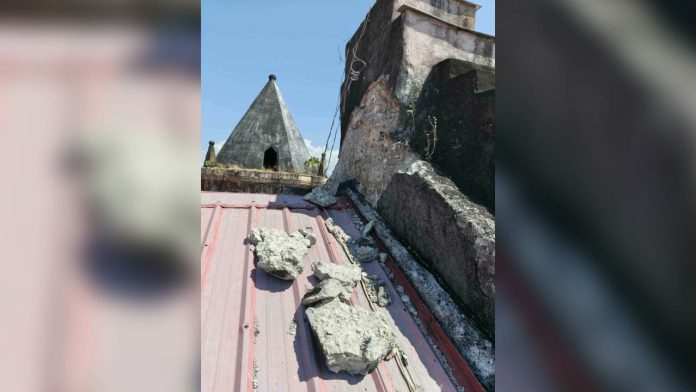
ILOILO — National government heritage agencies are set to inspect the iconic Miag-ao Church in southern Iloilo today, June 17, following damage caused by a magnitude 4.7 earthquake that struck nearby Antique province and parts of Panay Island on June 14.
The local government of Miag-ao imposed safety restrictions and initiated protective measures to safeguard the centuries-old stone church, one of the country’s most important cultural landmarks.
Representatives of the National Commission for Culture and the Arts (NCCA) and the National Historical Commission of the Philippines (NHCP) will conduct the post-earthquake assessment.
The inspection comes amid growing concerns over the structural integrity of the church, a UNESCO World Heritage Site and one of the country’s best-preserved examples of Baroque-Romanesque architecture.
The Municipal Tourism Office of Miag-ao announced the precautionary measures through a Facebook post on its “Tourism Miag-ao” page, informing the public of safety protocols being implemented while awaiting a detailed evaluation by heritage and structural experts.
Based on an initial assessment conducted by the NHCP, authorities have temporarily restricted public access to the famous church façade that features intricate, ornate bas-relief that blends medieval Spanish, Chinese, Muslim, and local Filipino elements.
Officials also recommended immediate protective measures for the church pediment due to possible risks posed by aftershocks, strong winds, or heavy rainfall.
In addition, a comprehensive interior inspection will be undertaken in coordination with local building officials to determine whether the structure remains safe for public use.
“We respectfully request the public’s cooperation and understanding as these precautionary measures are undertaken to ensure everyone’s safety and to help preserve one of Miag-ao’s most treasured cultural and historical landmarks,” the Tourism Miag-ao office said in a statement.
The office added that updates would be released once official findings and recommendations from heritage and structural experts become available.
Also known as the St. Thomas of Villanova Parish, the Miag-ao Church was built in 1734 and is renowned for its distinctive Baroque-Romanesque design, making it one of the most significant historical and religious structures in the Philippines.
At the very center of the church façade’s bas-relief is a large coconut tree representing the “tree of life”. Clinging to the coconut tree for support is a larger-than-life carving of St. Christopher carrying the Child Jesus on his shoulder. He is uniquely depicted wearing traditional, localized Filipino attire.
Above the main wooden doorway, just beneath St. Christopher, is a carved image of the town’s patron saint, St. Thomas of Villanova (Villanueva).
On either side of the main door are carved images of St. Henry of Bavaria and Pope Pius VI, complete with their respective coat of arms.
The rest of the relief showcases the daily life of the local Miag-aowanons and features recognizable indigenous plants and animals, such as papaya and palm trees.
Flanking the highly decorated facade are two massive, asymmetrically tall watchtower belfries that were originally designed to defend the town against Moro raids./PN