
By NELJOY N. GALIGAO
ILOILO City — The United States’ continuing ban on Philippine blue swimming crab (locally known as “kasag”) imports is threatening the livelihoods of an estimated 15,000 fishermen and processing workers in Western Visayas, prompting the Bureau of Fisheries and Aquatic Resources (BFAR) to fast-track compliance measures in hopes of restoring access to the country’s biggest export market.
BFAR Region 6 director Remia Aparri said the suspension, which took effect on June 11, 2026, remains in force and has placed one of Western Visayas’ most valuable fisheries industries under severe economic strain.

“Asta subong, ara gyapon ang suspension sang aton nga pag-export sang kasag or blue swimming crabs sa US,” Aparri said in an interview with Panay News.
The stakes are particularly high for Western Visayas, with Panay and Guimaras islands and Negros Occidental in the Negros Island Region producing nearly 60% of the country’s blue swimming crab supply, making the region the backbone of the Philippines’ crab export industry.
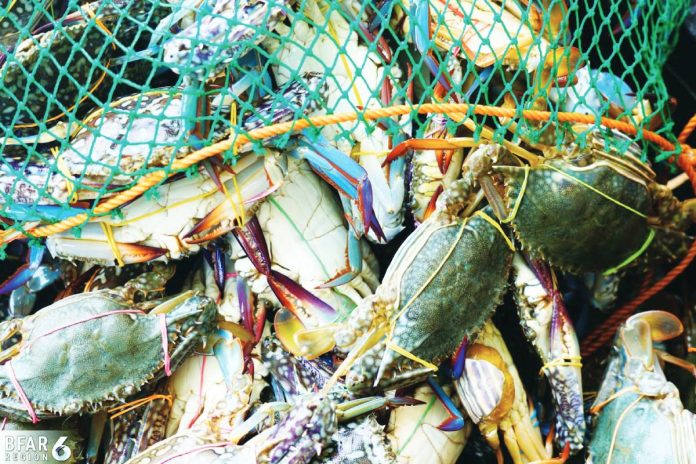
Blue swimming crabs are marine crabs with distinct paddle-shaped rear legs that allow them to swim, and they have bluish coloration (commonly seen in males). They are a prized seafood commodity because of their sweet, delicate meat, high meat yield and strong demand from processors, restaurants and overseas buyers, particularly for pasteurized canned crab meat.
According to Aparri, the United States imposed the ban after determining that the Philippines had yet to establish measures comparable to those required under the Marine Mammal Protection Act (MMPA), particularly on catch documentation, monitoring and protection of marine mammals.
“The reason for this suspension is that the US requires all exporting countries, including the Philippines, to establish comparable measures that protect marine mammals,” she said.
“The effect is felt by our fishers, landing sites, picking stations, and processors. In Western Visayas, particularly in the Visayan Sea, we contribute almost 60% of the country’s total crab production, with the majority sourced from Northern Iloilo and Guimaras,” Aparri emphasized.
She estimated that around 10,000 fishermen and another 4,000 to 5,000 crab meat pickers and processing workers stand to lose income because of the export restrictions.
“Based sa amon data, it’s about 10,000 ka fishers ang maapektuhan... we are exporting to the US roughly annually, 6 billion to 7 billion… plus ang mga crab meat pickers, processing workers… mga around 4,000 to 5,000 man nga mga line workers ang dependent diri,” she said.
The industry generates an estimated P6 billion to P7 billion annually from exports to the United States, the country’s largest market for blue swimming crabs.
Northern Iloilo municipalities such as Concepcion, Ajuy, Banate and Carles, along with Pilar, Capiz, are among the region’s major production areas.
To address the crisis, BFAR has begun coordinating with provincial governments, local government units and national agencies to satisfy US requirements.
“We have convened meetings at the provincial level, engaging with local officials, including Iloilo’s Gov. (Arthur) Toto Defensor,” Aparri said, adding that an executive order and supporting ordinances are being prepared to strengthen marine mammal protection and fisheries monitoring.
BFAR is likewise working with the Department of Social Welfare and Development (DSWD), Department of Labor and Employment (DOLE) and local governments to provide assistance to affected fishing communities.
“Sa mga fishermen, we conducted meetings with the different national government agencies… we also proposed sa central office ang intervention or livelihood support sa mga affected nga stakeholders or fisherfolk in Iloilo, especially in Northern Iloilo,” she said.
While exporters have alternative markets in Korea, China, Canada and Australia, Aparri acknowledged these cannot match the demand generated by the United States.
“May domestic market man ang kasag… Only ang pinakadako abi nga export market ang Philippines, in terms of kasag is the US,” she stressed.
She added that the ban has already begun depressing crab prices because of reduced export demand.
“Actually, may ara gid man nga negative effects because of the dependency… manubo na ang ila catch because wala sang export market. Medyo lower ang price sa domestic market,” Aparri said.
Among the companies affected is Saravia Blue Crab, which processes export-quality pasteurized canned crab meat using raw materials sourced largely from Western Visayas.
“Isa gid da is ma-apektuhan ang ila nga business… ang volume nila nga i-export mas lesser compared nga open ang market sa US So, sa business, medyo mabuhian ang ila nga profit… there are mga socioeconomic nga mga negative impacts with the situation now,” she said.
Despite the setback, BFAR hopes to submit the required documentation and evidence to US authorities by October in an effort to seek the lifting of the suspension.
“Based on the findings now and based on our intervention… the earlier, the better. Mga October. With that, sigurado nga mga evidence that we can submit to the US for their assessment,” Aparri said.
She said the government has organized an inter-agency task force involving BFAR, the Department of the Interior and Local Government (DILG), the Department of Environment and Natural Resources (DENR), and local governments to ensure compliance with U.S. standards.
“We have to cooperate, collaborate and work together,” Aparri said./PN