

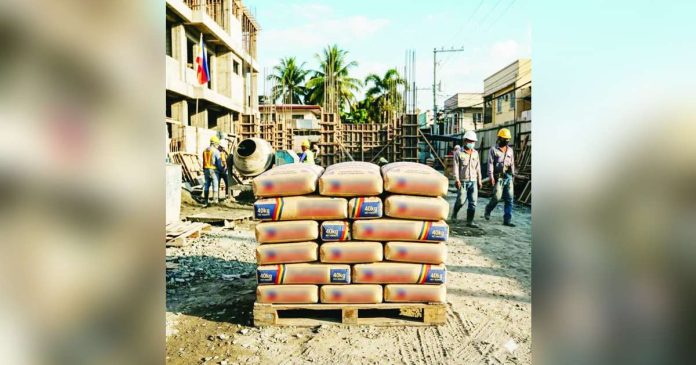
CEMENT manufacturers are no longer expecting demand growth this year, as slower government infrastructure spending continues to weigh on construction activity.
Nearly a year after the multibillion-peso graft scandal that had prompted tighter checks on public works projects, Cement Manufacturers Association of the Philippines (Cemap) president Reinier Dizon said the industry had yet to see a meaningful pickup in demand even after the peak construction season from February to April.
While the dry season typically boosts construction activity, Dizon noted that government infrastructure spending — which accounts for about 40 percent of total cement demand — remained sluggish.
“Government spending is slow,” said Dizon, who is also president of Republic Cement and Building Materials Inc. “We hope for at least a flat market.”
Although Cemap has yet to complete its full assessment of industry demand for the year, Dizon said the market would likely end 2026 with a single-digit contraction.
This, as infrastructure and capital outlays plunged 48 percent year-on-year to P59.1 billion in March, while first-quarter infrastructure spending dropped 43.5 percent to P147.8 billion, based on Department of Budget and Management data.
Even if government spending accelerates later this year, infrastructure activity may still remain constrained after the Department of Public Works and Highways received only P529.6 billion in funding this year, far below its original P881.3-billion proposal.
Dizon said that even private sector construction had yet to show signs of a significant recovery.
Apart from weak infrastructure spending, he attributed softer cement demand to inflationary pressures linked to the Middle East war, weighing on household finances and consumer confidence.
In April, Philippine inflation accelerated to 7.2 percent, the highest in three years and well above both market expectations and the Bangko Sentral ng Pilipinas’ forecast range of 5.6 percent to 6.4 percent for the month.
Still, Dizon said the industry expects 2027 to be “okay” as pre-election spending could support construction activity ahead of the campaign season.
Election rules prohibit new infrastructure and social service projects during the official campaign period, although ongoing projects are allowed to continue.
Apart from softer demand, Dizon also flagged cement imports flooding the Philippine market despite existing safeguard duties meant to protect local manufacturers from cheaper foreign products.
According to Dizon, the current safeguard measures do not cover all countries exporting cement to the Philippines.
Asked whether the industry was seeking broader protections, he said discussions with the government were still ongoing. (Logan Kal-El M. Zapanta © Philippine Daily Inquirer)