


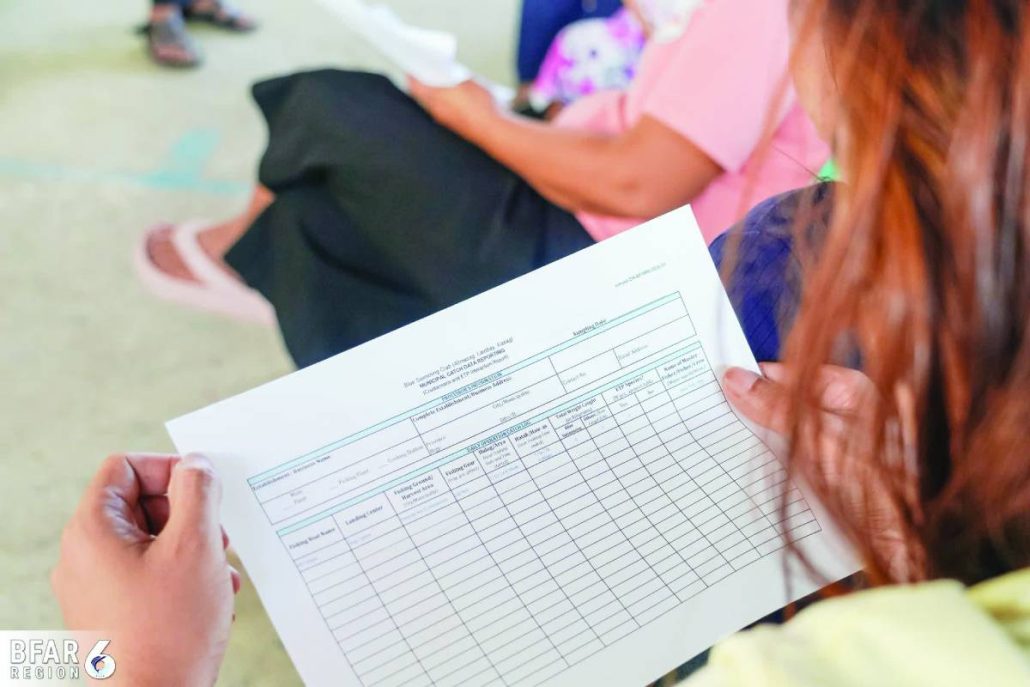
CONCEPCION, Iloilo — The Department of Agriculture – Bureau of Fisheries and Aquatic Resources Regional Office 6 (DA-BFAR 6) has rolled out a new Blue Swimming Crab (BSC) Municipal Catch Data Reporting Form in Concepcion, Iloilo as part of urgent efforts to help the Philippine crab industry comply with United States regulations and eventually lift the suspension on blue swimming crab exports — a setback that threatens the livelihood of thousands of fishers and crab workers across Western Visayas.
The new reporting system was introduced during a stakeholder dialogue in Barangay Igbon, Concepcion, where BFAR gathered fishers, crab pickers, consolidators, and local officials to strengthen catch documentation and monitoring of marine mammal interactions.
The initiative comes after the United States suspended imports of Philippine blue swimming crab effective June 11, 2026 under the Marine Mammal Protection Act (MMPA), requiring exporting countries to adopt monitoring systems comparable to US conservation standards.
Almost 60 percent of the country’s blue swimming crab production comes from Panay, Guimaras and Negros Occidental, making Western Visayas one of the regions hardest hit by the suspension.
According to BFAR-6 regional director Remia Aparri, the enhanced monitoring program is a critical requirement for regaining access to the lucrative US market.
“The reason for this suspension is that the US requires all exporting countries, including the Philippines, to establish comparable measures that protect marine mammals,” she said.
The United States also requires comprehensive documentation, proof of compliance, and mitigation measures based on catch monitoring and reporting systems before imports can resume.
Aparri, who chairs the Blue Swimming Crab National Technical Working Group (BSC-NTWG), reaffirmed BFAR’s commitment to helping the fishing community improve its economic prospects.
“We look forward to the day when the pickers and fishers of Igbon can identify improved livelihoods as a result of our support. We have designated Igbon as a model village for the BSC industry, which reflects our confidence in your work and dedication,” Aparri said.
Igbon is one of Iloilo’s major blue swimming crab-producing communities, with about 400 licensed crab fishers and 240 crab pickers based on BFAR profiling. The village also hosts five crab picking plants that support the province’s seafood industry.
Women comprise a large portion of the local crab-picking workforce, many having inherited the trade from their mothers. Most are paid on a piece-rate basis, earning around P200 to P500 a day depending on crab supply, while their husbands catch crabs using gill nets.
However, participants said declining crab catches and prolonged periods of bad weather have significantly reduced their income, with a week of low-pressure weather often resulting in a week without work.
During the consultation, stakeholders proposed alternative livelihood projects, including converting an unused crab-picking station into a salon and venturing into smoked sardine production and poultry egg-laying enterprises.
Sheryll Mesa, head of the BSC-NTWG Secretariat, also briefed participants on the National Oceanic and Atmospheric Administration (NOAA) Fisheries’ Comparability Finding and the country’s ongoing national stock assessment and dockside monitoring efforts.
Meanwhile, Maria Lea Mandalejo of the BFAR Iloilo Provincial Fisheries Office oriented consolidators and receivers on the proper use of the new municipal catch reporting form.
Also present during the dialogue were BFAR-6 Fisheries Management, Regulatory and Enforcement Division chief Erwin Ilaya, Iloilo Provincial Fisheries Office officer-in-charge Maria Aimee A. Sobrevega, and representatives from the Concepcion local government unit.
BFAR said the new reporting system is expected to improve fisheries data collection, strengthen resource management, and help secure the long-term sustainability of the country’s blue swimming crab industry./PN