
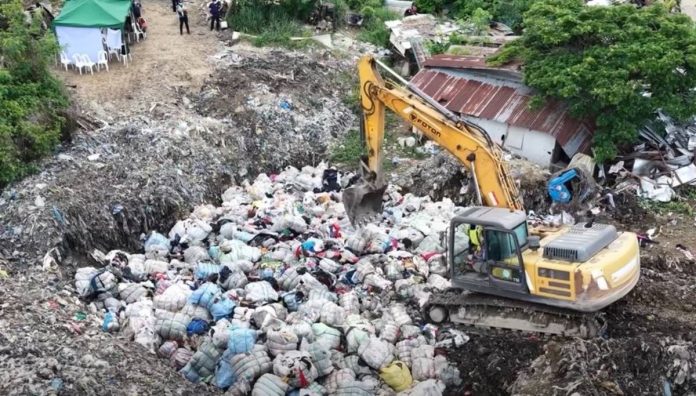
ILOILO City – The city government clarified that it had no role in deciding the fate of more than 2,171 bales of forfeited ukay-ukay worth P15.4 million, saying it merely complied with a Bureau of Customs (BOC) request to bury the confiscated shipment at the city’s sanitary landfill despite concerns that the move would consume valuable landfill space and undermine the city’s circular economy program.
General Services Office (GSO) head Engr. Neil Ravena said the shipment, consisting of 2,171 bales, 160 sacks and four boxes of used clothing weighing about 127 metric tons, had been confiscated by the BOC after being improperly declared.
The goods were stored for several months in a rented warehouse while the Bureau completed condemnation proceedings and secured approval from its auditor for disposal before requesting the city government’s assistance.
“The Iloilo City Government was only the recipient of the disposal request. The Bureau of Customs already completed its legal process, and the disposal method had already been approved by their auditor. The only process allowed was disposal in a sanitary landfill,” Ravena said.
He explained that the Calajunan Sanitary Landfill in Mandurriao was selected because it is the only operational sanitary landfill in Panay capable of accommodating such a large volume of condemned materials.
Ravena admitted the city initially resisted the burial plan because it conflicted with Iloilo City’s long-term goal of promoting a circular economy and maximizing resource recovery.
“Medyo na-delay because I was negotiating if puwede siya maging part sang circular economy instead of disposing it in our sanitary landfill. We know for a fact that textiles take around 20 to 30 years to deteriorate, so we explored whether there were other environmentally sound options,” he said.
Despite the proposal, Ravena said the city had no authority to alter the BOC’s approved method of disposal.
“The condemnation process is very clear. They have a legal process that they are required to follow, and once it was approved, we had to respect it. Amo na nga nag-end up kami sa final decision to dispose of the condemned and forfeited ukay-ukay in our sanitary landfill,” he said.
Around 10 truckloads transported the confiscated items to Calajunan, where an excavator dug a deep pit to ensure the used clothing remained permanently buried.
“What we did in our landfill was dig a large hole, and that’s where we placed all the forfeited items. The reason we used an excavator was to ensure that the materials were completely buried inside the sanitary landfill,” Ravena said.
He acknowledged that burying more than 127 metric tons of textile waste inevitably shortened the landfill’s operational lifespan.
“It definitely added to the waste volume and reduced the remaining life of the sanitary landfill. However, technically, that was the required process. They coordinated with us, and we assisted them in disposing of the forfeited items because that was the only legally approved mode of disposal,” he said.
Ravena also believes the BOC opted for burial to prevent the confiscated goods from finding their way back into the market.
“One of the reasons I see is that they did not want these items to be recovered for further use. If they were left accessible, waste pickers or even some employees could retrieve them, and there is always the possibility that they would be sold again. I believe those were among the scenarios the Bureau of Customs wanted to avoid,” he said.
The experience, he added, has prompted the city to push for policy reforms before the National Solid Waste Management Commission, urging national agencies to adopt disposal methods that prioritize recycling and resource recovery instead of outright burial.
“If the confiscated materials belonged to the city government, we could process them through our Integrated Solid Waste Management Facility and convert them into refuse-derived fuel. That is more consistent with our circular economy program. Unfortunately, because these were Bureau of Customs forfeited goods, we had to comply with their legal process,” he said.
Ravena said the city is also working to secure permits from the Department of Environment and Natural Resources (DENR) that would allow certain condemned materials to be recovered and recycled in the future, reducing landfill waste while supporting Iloilo City’s long-term sustainability and circular economy initiatives./PN