


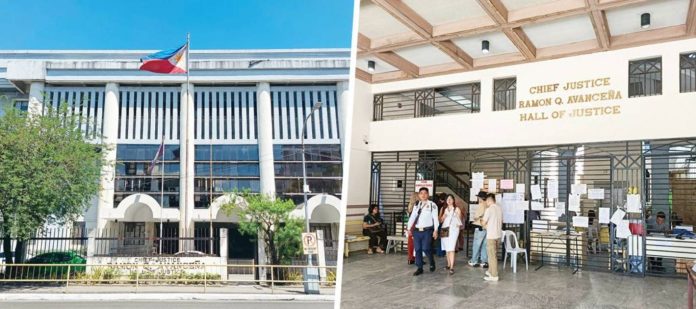
ILOILO City – The few courts still operating at the Chief Justice Ramon Q. Avanceña Hall of Justice in the City Proper continued functioning without disruption following a magnitude 4.8 earthquake on March 2, with engineers reporting no new cracks in the decades-old structure while authorities await the official assessment of national government inspectors.
Currently occupying four floors of the building are the Department of Justice, five Regional Trial Courts (RTCs), and three Municipal Trial Courts in Cities (MTCCs).
Most other courts moved out last year as a precautionary measure following a series of strong earthquakes, including the magnitude 6.9 quake in Bogo City, Cebu on Sept. 30 and the magnitude 7.4 offshore tremor in Davao Oriental on Oct. 10, both of which sent tremors across Iloilo and neighboring provinces.
Fourteen RTC offices are currently operating at the New Castle Hotel just across the Iloilo Hall of Justice, while six MTCC offices are holding office in the nearby Annex Building.
One remaining MTCC is also temporarily based at the New Castle Hotel.
There are no indications that these offices will move back to the Iloilo Hall of Justice amid continuing safety concerns.
Also last year, the Public Attorney’s Office (PAO) Regional Office and Iloilo City District Offices 1 and 2 moved out of the Iloilo Hall of Justice and transferred to the Casa Real de Iloilo, while the Provincial Prosecutor’s Office relocated to the Iloilo Sports Complex.
After the March 2 quake, an internal inspection conducted by engineers assigned to the Hall of Justice found no additional damage around the complex, according to Engr. Manuel Autajay Jr., Administrative Officer III.
“Same man gihapon,” Autajay said in an interview with Panay News when asked whether it remains safe for personnel to continue holding office at the Iloilo Hall of Justice.
The building’s management has also requested engineers from the Department of Public Works and Highways (DPWH) Regional Office 6 to conduct a separate structural inspection.
Autajay said DPWH engineers carried out their assessment on Wednesday, March 4, but their official findings have yet to be submitted.
As a precautionary protocol implemented last year after a series of tremors, visitors and litigants are generally received at the ground floor of the Iloilo Hall of Justice, with access to upper floors allowed only for those attending scheduled hearings in the courts.
As to the proposed construction of a new hall of justice, Autajay said such ultimately depends on the Supreme Court, which provides funding for judiciary infrastructure.
However, based on initial information, he said the Supreme Court is considering retrofitting the building instead of constructing a new one.
The structural integrity of the Iloilo Hall of Justice was seriously questioned over 13 years ago. It incurred cracks from a magnitude-5.7 earthquake on February 6, 2012.
In October last year, during a visit to Iloilo by Supreme Court Administrator Ma. Theresa Dolores Gomez-Estoesta and Region 6 Court Manager Judge Jennie Ann Logronio, judiciary officials sought assistance from Iloilo’s Gov. Arthur Defensor Jr. in identifying a possible site for a new Hall of Justice.
Defensor offered an eight-hectare property owned by the Iloilo provincial government in Barangay Guinobatan, New Lucena town as a potential location for a future judiciary complex.
The property had originally been considered as one of the proposed sites for a provincial government Center, which will now instead be constructed in the municipality of Santa Barbara.
The governor expressed the provincial government’s willingness to assist the judiciary in addressing its long-term infrastructure needs.
After the magnitude-5.7 earthquake on February 6, 2012, judges, lawyers and court employees at the Iloilo Hall of Justice called on the government to construct a new hall of justice instead of merely repairing the existing one.
Only a retrofit, however, was conducted.
The Iloilo Hall of Justice was completed in 1992 during the administration of President Corazon Aquino at a cost of P200 million./PN