


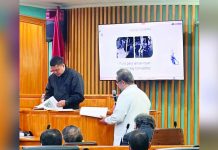

THE CONTROVERSY sparked by Cong. Toby Tiangco’s question during the House Appropriations Committee’s budget briefing is more than a political theater. It is a constitutional issue. By requesting the 2025 Small Committee report, Tiangco exposed a fundamental flaw in legislative procedure.
The confusion voiced by the Committee Chair that the outputs of the Small Committee were already “embedded” in the House General Appropriations Bill reflects a troubling misunderstanding of Philippine legislative processes. Under both constitutional principles and the House Rules, a bill and a committee report are not interchangeable.
A bill, as defined under legislative practice, is a draft statute. It is a proposal that embodies the text of a potential law. It is the instrument by which lawmakers initiate legislation. A committee report, however, is the official output of a committee’s deliberation on that bill. Such a report contains the committee’s findings, the rationale for its recommendations, and the record of whether the measure should be approved, substituted, or rejected.
This distinction is not mere semantics. The committee report serves as the documentary basis of legislative accountability. It explains the “why” and the “how” behind the provisions that eventually appear in the bill. Without it, the legislative process becomes opaque, preventing both fellow lawmakers and the public from understanding the reasoning behind fiscal and policy decisions.
The case of the missing 2025 Small Committee report raises profound implications. The annual national budget, crafted through the General Appropriations Bill, is not an ordinary statute. Article VI, Section 25 of the 1987 Constitution vests Congress with the “power of the purse,” giving it authority to determine how public funds are to be allocated. This power must be exercised with the highest degree of transparency and responsibility, as every peso appropriated comes from public revenues.
If committee reports on budget deliberations are absent or worse, deliberately withheld, then the principle of public accountability under Article XI of the Constitution is undermined. Public office, as the Constitution declares, is a public trust. That trust demands a clear record of deliberations, not a legislative process that operates behind closed doors.
Moreover, jurisprudence has consistently emphasized the importance of transparency in governance. In Senate v. Ermita (G.R. No. 169777, 2006), the Supreme Court affirmed the people’s right to information on matters of public concern, especially where public funds are involved. The absence of a committee report in the budget process directly contravenes this right, depriving both legislators and citizens of the information necessary to hold government accountable.
Cong. Tiangco’s intervention thus highlights more than a procedural irregularity. It underscores a constitutional breach. A budget law passed without its accompanying committee report may stand formally as a statute. Still, it suffers from a deficit of legitimacy, as the required process of deliberation and documentation has not been properly observed.
The House must recognize that the integrity of its lawmaking process rests not only in passing bills but also in safeguarding the records that justify them. A bill is the vessel of law. A committee report is its compass. To conflate the two, or to discard one, is to abandon the very principles of accountability upon which democratic legislation rests./PN