



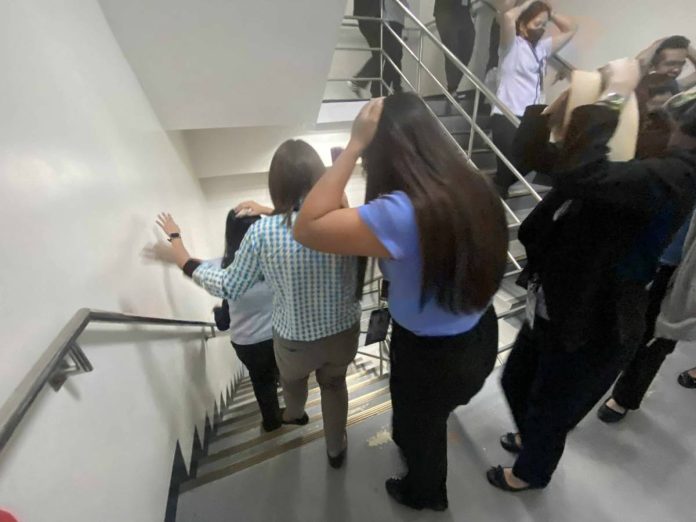
ILOILO – The Office of Civil Defense (OCD) in Region 6 sounded the alarm over the public’s continued complacency toward earthquake drills, warning that lack of preparedness could prove deadly should the West Panay Fault unleash the region’s version of the “Big One.”
“Earthquakes are unpredictable. They strike without warning, which makes our preparation crucial. A resilient community is built on infrastructure that meets safety standards,” said OCD-6 director Raul Fernandez, who also chairs the Regional Disaster Risk Reduction and Management Council (RDRRMC).
He emphasized that the public’s tendency to treat earthquake drills as a formality, especially among private companies, could lead to panic and injuries in a real seismic event.
“Actually, quarterly meron tayong national simultaneous earthquake drill, but we’re not taking it seriously,” Fernandez lamented.
The OCD-6 chief said many establishments, including business process outsourcing (BPO) companies, still fail to participate in the drills despite repeated reminders.
“If you know what to do and where to go during an earthquake, you significantly reduce the chances of panic attacks that can occur when faced with an emergency,” he explained.
Fernandez noted that preparation must go beyond mere compliance.
“What we can do now is to prepare the people and the communities — mentally and physically, and even psychologically. Of course, we’re doing drills, but the biggest challenge is the mental effect of earthquakes on people. Ang iba nagkakaroon ng panic attack because we don’t know what to do,” he said.
The OCD-6 official stressed that infrastructure resilience is equally critical, warning that many buildings in Western Visayas remain below safety standards.
“Structures adhering to construction standards often sustain far less damage. Our region, however, is still home to many buildings that do not meet these safety requirements, leaving us vulnerable,” he added.
To address this, Fernandez urged the retrofitting of old structures and strict compliance with the National Building Code for new constructions.
“Preparedness is not just about being aware; it’s about being ready. When an earthquake strikes, it’s the moments of chaos that will test our resilience,” he said.
He also discouraged the public from recording videos during drills or actual earthquakes.
“Kailangan nilang malaman yung risks in doing that. Isa sa mga downside ng social media ay people are putting themselves at risk unnecessarily. We will be needing the help of the media to share the info on earthquake risks,” he stressed.
Fernandez reminded the public of basic safety steps: “Mag-drop ka muna para di ka mahilo, cover your head, and if may sturdy furniture, doon ka mag-cover and hold on. Once the shaking stops, calmly walk to the exit.”
The OCD-6, under the direction of Defense Secretary Gilberto Teodoro Jr., is preparing a large-scale regional earthquake and evacuation drill covering Antique, Iloilo, Iloilo City, Capiz, Aklan, and Guimaras. The activity will be coordinated with local disaster councils to ensure readiness across all levels.
Recent tremors have heightened concern: a magnitude 6.9 quake hit Bogo City, Cebu on Sept. 30; a 7.4 magnitude temblor rocked Davao Oriental on Oct. 10; and a 4.4 quake jolted Guimbal, Iloilo on Oct. 15.
Fernandez warned that Western Visayas is not immune from a major seismic event.
“Parati nating naririnig ang ‘Big One’ sa Manila dahil sa West Valley Fault, but in our region, we also have the potential na magkakaroon ng big one dahil may tinatawag tayong West Panay Fault system running from Aklan, Antique, Iloilo and Capiz,” he said.
“The last time na gumalaw yung fault was in January 15, 1948, but right now, marami na tayong high-rise buildings na pwedeng gumuho at magdulot ng injuries and death. So we have to be proactive and serious about our preparedness,” Fernandez warned./PN