


ILOILO — Determined to reverse decades of environmental degradation, the Iloilo provincial government has launched a long-term strategy to restore its vanishing forests and achieve full ecological rehabilitation by 2044 — a bold move that redefines its development agenda around sustainability and climate resilience.
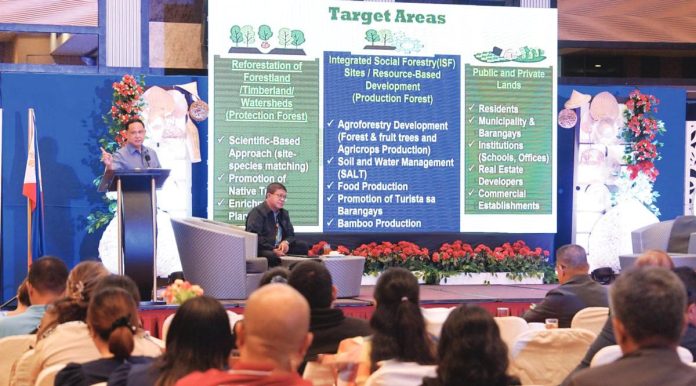
The commitment was made during the “Stakeholders Summit Towards a Forest Province” held on Oct. 6. The gathering brought together local officials, civic groups, environmental advocates, and private sector representatives to align policies and investments under a unified reforestation framework.
Gov. Arthur Defensor Jr. said the province’s transformation into a “Forest Province” is not just an aspiration but a shared mission to heal the environment and secure the future of the next generation.
“Our vision for a Forest Province represents more than just a goal — it is a comprehensive commitment to restoring and protecting our natural resources for future generations,” he asserted.
The province’s flagship initiative, Tanum Iloilo for MoRProGRes, created through Executive Order No. 195, Series of 2024, serves as the blueprint for the campaign. Backed by scientific mapping and data from the Department of Environment and Natural Resources (DENR-6), the program targets to rehabilitate critical areas within Iloilo’s 471,940 hectares of total forestland, including 357,857 hectares of classified forest zones and 114,083 hectares of alienable and disposable lands.
A highlight of the summit was the unveiling of the MoRProGRes Forest Map, a strategic planning tool pinpointing degraded and high-risk watershed areas for reforestation. This map will guide future planting activities and ensure that resources are concentrated where they can make the greatest environmental impact.
Provincial Administrator Raul Banias stressed the program’s economic and social dimensions.
“Our forests are not merely resources for extraction; they are vital components of our life-sustaining systems and essential for economic stability. We must incorporate the success of Tanum Iloilo into the core mission of every organization in attendance,” he said.
The summit coincided with the 25th anniversary of the Piyesta sa Kakahuyan, a festival that celebrates tree-planting and community participation in environmental protection.
Workshops and tree-planting activities during the event encouraged participants to adopt sustainable agricultural practices and explore eco-tourism initiatives that can both protect and profit from Iloilo’s natural landscapes.
With its roadmap extending two decades into the future, Iloilo’s Forest Province vision is set to redefine local governance around sustainability, climate adaptation, and biodiversity protection. If realized, the province could become one of the Philippines’ pioneering models for ecological recovery — proving that local action, when united and sustained, can turn environmental decline into a legacy of regeneration./PN