

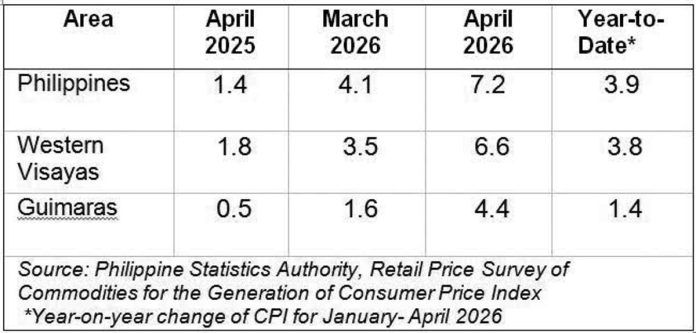
THE HEADLINE inflation rate in Guimaras surged to 4.4% in April 2026, a significant acceleration from the 1.6% recorded in March. Despite the jump, the province’s year-to-date average inflation for January to April 2026 settled at a modest 1.4%.
According to the Philippine Statistics Authority (PSA), the province’s April figure remained lower than the prevailing inflation rates at both the national and Western Visayas regional levels.
Provincial Statistics Officer Nelida B. Losare identified three major commodity groups as the primary sources of the April uptrend:
* Food and non-alcoholic beverages posted a 1.1% inflation rate, contributing 57.9% to the overall acceleration.
* Transport recorded a sharp 31.2% inflation rate, accounting for a 32.5% share of the increase.
* Housing, water, electricity, gas, and other fuels registered at 3.3%, making up 5.2% of the upward movement.
Within the food sector, cereals and cereal products, particularly rice, registered a 4.3 percent inflation rate and contributed 92.5 percent to the commodity group’s inflation. Other notable contributors included fruits, nuts, and soft drinks.
However, in terms of total impact on the provincial economy, Transport remained the top contributor to overall inflation with a 54.3% share.
“This was mainly due to the faster price change of Gasoline with 53.6% inflation rate and contributed 20.1% or 0.88 percentage point to the overall inflation, followed by passenger transport by sea and inland waterways registered a 152.4% inflation rate and contributed 19.9% or 0.87 percentage point, and diesel which contributed 9.5% or 0.42 percentage point after posting a 101.7% inflation rate,” Losare said.
The utilities sector was driven primarily by an 8.5% increase in electricity costs and a 28.2% spike in gas prices. Other sectors that saw faster price movements included Alcoholic beverages and tobacco (4.7%) and Personal care services (4.3%).
Conversely, lower inflation rates were observed in Clothing and footwear (3.3%), Health (5.8%), and restaurant services (3.8%). Education services remained in negative territory at -0.8%.
“The CPI (Consumer Price Index) serves as the primary indicator used in computing the inflation rate, as it tracks movements in the prices of a fixed basket of goods and services typically consumed by households,” Losare explained.
This means, she added, that a typical Guimarasnon household d now needs P1,382 to buy the same items that cost P1,000 in the 2018 base year.
Meanwhile, the Purchasing Power of the Peso (PPP) in Guimaras dipped to P0.72 in April, down from the P0.74 maintained during the previous two months./PN