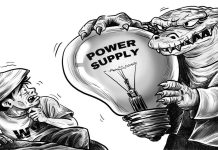



IN A PREVIOUS column, I said that when it comes to Manual Load Dropping (MLD), blame the National Grid Corporation of the Philippines (NGCP), not MORE Power. But a friend who is an industry insider told me, “Blame the generating plants and the Department of Energy (DOE).” I quite agree. So perhaps it should be: “Blame NGCP, the generating plants and DOE.”
It’s almost October, and yet there seems to be no concrete solution to this power crisis affecting the Visayas, particularly the city and province of Iloilo. All we’re hearing so far are band-aid solutions that, as of press time, have not even been implemented.
Perhaps it was exasperation over the seeming helplessness of the situation that prompted “I Am Iloilo City” Councilor Rex Sarabia to come out with these statements:
“Unplanned or forced outages of major power generation plants are not valid excuses for the lack of power in the grid. The claim that old power plants are susceptible to unplanned or forced outages is not a valid excuse.
“The extended consecutive period of brownouts is a clear showing of government incompetence.
“The admission of the decay of our power generation sector and public utilities without clear and immediate solutions shows a lack of direction and commitment to public service and economic guardianship.”
And there was more, but we’ll stop there.
It’s a fact that “I Am Iloilo City’s” sole power distribution utility, MORE Power, is as much a victim of this power crisis as the consumers. The reason is simple: MORE Power is a power distribution utility, not a power generator. Without electricity coming from generating plants and transmitted through the NGCP grid, it has nothing to distribute to consumers. No power, no revenue.
“If there’s no supply, there’s nothing to distribute,” MORE Power said, explaining that distribution utilities can only deliver electricity that is available from the grid.
In other words, while distribution utilities are responsible for delivering electricity to consumers, the current interruptions are largely being triggered by constraints in generation supply upstream.
Simply put, the problem starts when there is not enough electricity being generated to meet the total demand of consumers.
Indeed, MORE Power has not taken this power crisis lying down. On its own initiative, it has committed to putting up a 40-megawatt facility — the MORE Electric and Power Corporation Barge in Guimaras. The MORE Power Barge is expected to provide an additional 40 megawatts (MW) for its franchise area and is targeted to become operational in the first quarter of 2027.
I suppose it would also be fair to say that DOE is making some effort to mitigate this energy crisis.
According to the Department of Energy (DOE), a total of 253 MW in battery energy storage system (BESS) capacity is being deployed across the Visayas in 2026 to help address supply constraints and support grid stability.
This includes 63 MW in Cebu, 50 MW in Panay, 100 MW in Negros and 40 MW in Leyte. These battery systems are intended to provide additional flexibility to the grid by storing electricity and releasing it when additional supply is needed.
DOE has also said that Panay Island is being lined up for a major expansion of its power supply, with 555 MW of additional baseload capacity expected to come online between 2028 and 2030.
Meanwhile, I’ll put my faith in MORE Power’s 40-MW power barge becoming operational in the first quarter of 2027 because, so far, MORE Power has always been reliable.
Moving on, here’s some good news. The Philippine Economic Zone Authority (PEZA) and Primelectric Holdings, Inc. (PHI) have signed a Memorandum of Understanding (MOU) to explore the development of electricity distribution systems within PEZA economic zones.
Under the MOU, PEZA will identify priority ecozones for study, while PHI will conduct feasibility assessments and evaluate the operational viability of establishing power distribution systems in these areas. PHI brings to the partnership its established experience in power distribution through MORE Electric and Power Corporation, Negros Electric and Power Corporation, and Bohol Light Company, Inc., providing PEZA with access to a partner with a proven track record in operating electricity utilities outside Metro Manila.
Finally, hope springs eternal. But we will not sit helplessly hoping. Instead, we will rage against the dying of the light./PN