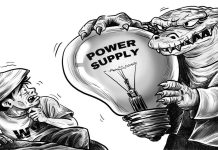




MENTION the word decarbonization, and you will be ushered into its significant definition: reducing carbon dioxide and other greenhouse gas emissions.
In this modern era, characterized by rapid industrialization, why is it a must for us to embrace decarbonization?
The simplest answer: excessive greenhouse gas emissions cause dangerous changes to our global climate.
And what are the dangerous changes in our climate and weather systems that we are experiencing from time to time in our generation?
Let me enumerate some of them:
* global warming
* heatwaves
* droughts or the El Niño phenomenon
* flooding associated with the La Niña phenomenon
* severe storms or super typhoons
* wildfires
* storm surges
CARBON-NEGATIVE PIONEERS
Around the globe, several countries have emerged as pioneers in cutting carbon emissions.
Meaning, they take decarbonization seriously by investing heavily in renewable energy (RE), even as they continue to pursue industrialization.
These countries include:
* China
* Iceland
* Norway
* Bhutan
* Panama
* United Kingdom (UK)
* Denmark
China, based on my research, aims to peak its carbon emissions before 2030 and achieve carbon neutrality by 2060 under its dual carbon targets.
By 2050, the UK aims to meet its net-zero carbon target.
Bhutan, on the other hand, has a constitutional mandate requiring at least 60% of its land to remain under forest cover, helping the country maintain its carbon-negative status.
See?
SISYPHEAN CHALLENGE
How about us?
What is the Philippines’ take on decarbonization?
Well, under the famous Paris Agreement, we pledged to reduce our greenhouse gas emissions by 75% by 2030.
However, it remains a pledge.
Question: What are we doing now?
Enter the Lopez-led First Gen Group and the Net Zero Carbon Alliance (NZCA).
Both face a Sisyphean challenge: convincing other companies and even the government to join their decarbonization crusade.
It is worth noting that exactly five years ago, NZCA started with only seven allied companies.
Now, it has more than 50 collaborators — airline and manufacturing companies, real estate firms, and others.
Quite impressive.
BINDING CONSTRAINTS
Yet, after five years of continuously advocating for decarbonization, NZCA still faces several binding constraints that form part of the “silent storms” hampering this benevolent crusade.
These silent storms include:
* the absence of a specific law or state policy on decarbonization;
* red tape or corruption in government;
* inadequate transmission facilities; and
* the government’s limited financial capacity to fund green financing for a just energy transition from fossil fuels to renewable energy.
These silent storms were brought to light during the two-day celebration of NZCA’s fifth anniversary and conference held at the Philippine Trade Training Center (PTTC) in Pasay City on September 15 and 16.
I was fortunate to have been invited to attend such a worthwhile event.
Now, let’s take a look at each storm.
Each carries a deeper meaning.
How can we meet our targets under the Paris Agreement when we don’t even have a clear state policy on decarbonization?
Where are our lawmakers?
Red tape?
It is an old problem in government transactions, especially during the permitting stage.
Let’s hope for an immediate cure.
An inadequate transmission grid?
The government must take notice of this serious matter; otherwise, we will just keep wasting our renewable energy potential.
Above all, there is the issue of financial capability.
We have lost trillions of pesos to corruption, and yet the government cannot set aside specific funds for green financing.
What “sheer insanity”!
STEEP ENDEAVOR
Anyway, thanks to the Lopezes for carrying the torch in pursuit of this noble mission: decarbonization.
This is a steep endeavor.
But having NZCA at the forefront of the mission connotes seriousness, which is exactly what the country needs right now.
But when will the government wake up and make decarbonization a priority?
Although the Lopezes are wealthy, their decarbonization mission still needs government support — and the government needs them just as much.
Decarbonization requires a sustained commitment.
And this must be a shared commitment among all Filipinos, not just the Lopezes, First Gen or NZCA alone.
DOMESTIC DAMAGE
But why are the Lopezes so keen on decarbonization?
For profit? No.
They simply know the economic impact that excessive carbon emissions can bring.
Without decarbonization, the country risks serious domestic damage, putting three things in jeopardy — the economy, energy security and climate stability.
In short, the Lopezes are thinking ahead.
Thus, more than 50 other businesses have followed them.
Call it shepherding the flock toward saving both the environment and the economy.
It is a worthy undertaking, even if the road ahead remains long and winding.
However, I believe the Lopezes know the path they are traversing.
It is not all about business and profit.
It is also about caring for the environment.
After all, Nobel Peace Prize laureate Wangari Maathai said, “The environment and the economy are really both two sides of the same coin. If we cannot sustain the environment, we cannot sustain ourselves.”/PN