
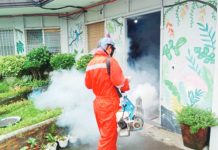



THE HAZE is unbearable. Seriously, why are we made to suffer from a hazardous fallout of a domestic situation in faraway Indonesia?
Toxic air that compromises public health, restricts breathing, and blankets entire regions in haze is a contemptible experience. And this time, let’s be entirely clear about where the blame lies: Indonesia must be held accountable! We must say it like it is. No sugar-coating.
Every dry season, the routine repeats itself. Relentless peatland and forest fires in Kalimantan rage out of control, sending plumes of transboundary smoke across borders and into our skies – Philippine skies, and this time, up to Bohol! And we’re not happy.
Let’s put to rest any attempts to dilute the issue: Official advisories from environmental and meteorological agencies confirm this is driven by land clearing and agricultural burning. Domestic negligence miles away is forcing an environmental hazard on us, turning our homes into gas chambers while we are left to suffer the toxic fallout indoors. This is outrageous.
What’s our data?
DENR-EMB Region 7 (Central Visayas) and DENR-EMB Region 10 (Northern Mindanao) have released consecutive formal advisories and real-time monitoring data throughout September 2026. They explicitly attributed hazardous and “acutely unhealthy” Air Quality Index or AQI levels in Cebu, Bohol, and Cagayan de Oro to smoke and transboundary pollution carried from fires in Kalimantan, Indonesia.
The ASEAN Specialised Meteorological Centre has continuously tracked and raised regional alert levels based on satellite monitoring of widespread hotspots, agricultural land clearing, and multi-hotspot smoke plumes dense over Kalimantan.
The Indonesian Ministry of Environment and Forestry and National Disaster Mitigation Agency, in their regular domestic reporting, have acknowledged that a vast majority of the fires during dry spells and El Niño cycles are linked to agricultural burning and corporate/individual land clearing across Sumatra and Kalimantan.
So, there.
In Bohol, this environmental failure has turned agonizingly personal. Since September 18, 2026, unhealthy air quality and thick haze affecting Central Visayas, including Tagbilaran City and the rest of Bohol, have been caused by transboundary smoke and particulate pollution. Our bright skies have turned a dismal grey. I am forced to keep windows shut against the invisible grit, and children, the elderly, and those with respiratory vulnerabilities are told to stay indoors. We are paying the price in our own backyard for a disaster we had no hand in creating.
That’s why we must make Indonesia accountable.
So why do we keep enduring it every time? The answer lies in the paralysis of regional politics. If we want real teeth in this fight, we must look straight at the framework that has coddled this crisis for decades: the ASEAN Agreement on Transboundary Haze Pollution (AATHP). Every single member state has ratified it, yet it remains crippled.
What is AATHP? It is a legally binding environmental agreement signed by all ten ASEAN member states designed to tackle land and forest fires through joint monitoring and prevention.
In fact, official government records and legal archives (such as the Law Library of Congress and regional legal summaries) document that the Indonesian House of Representatives formally voted to ratify the AATHP on September 16, 2014, making Indonesia the tenth and final ASEAN member state to complete the ratification process.
So, what gives?
The “ASEAN Way” is not helping at all.
Why? Because it is a foundational diplomatic model that prioritizes polite consensus, informal dialogue, and a deep cultural aversion to public confrontation over actual justice. By design, the ASEAN Way is the exact mechanism that sabotages accountability and blocks any real penalties. It relies on a few sacred cows that turn regional institutions into paper tigers:
The sacred cow of non-interference: Under this rule, a member state’s domestic policies – whether they involve corporate agriculture regulations or environmental enforcement in Kalimantan – are treated as strictly internal affairs.
Question: How can the issue of transboundary haze affecting other ASEAN nations be kept internal now? The moment Indonesia’s haze entered the air of other member states, compromising the health of their citizens, the issue is no longer internal.
The paralysis of absolute consensus: ASEAN makes decisions through absolute consensus rather than majority rule, meaning a single offending state holds an effective veto over regional policy. If a country facing criticism objects to binding rules or independent monitoring, the entire regional body is handcuffed.
Voluntary compliance over binding law: Regional instruments are systematically watered down into voluntary frameworks. Because the system rejects supranational laws or external judicial oversight, compliance relies on “goodwill” rather than enforceable legal mandates. Give us a break!
Saving face over saving lives: Regional harmony and institutional politeness are consistently prioritized over public transparency, swift justice, or financial penalties.
As long as ASEAN hides behind this diplomatic shield, treaties remain toothless, and citizens are left to choke on smoke while diplomats prioritize politeness over clean air. What nonsense!
We don’t need another polite regional panel, another empty declaration drafted to protect diplomatic feelings, or another toothless summit. Clean air is a basic human right, not a regional casualty subject to a political veto. The AATHP must be urgently overhauled to include binding legal accountability, independent third-party monitoring, and severe economic and financial sanctions for nations that fail to suppress transboundary environmental hazards.
If Indonesia cannot – will not – stop the burning at its source, the rest of the region should not be forced to bear the toxic cost in silence. It is time for ASEAN to drop the kid gloves, ditch the empty talk-shops, and prove that its environmental treaties carry actual consequences. Until then, we in the Visayas, Tagbilaran City included, Mindanao, and across the country are left demanding what should have been guaranteed: accountability, enforcement, and the simple right to breathe clean air.
ASEAN, act now!
***
The author owns and manages Belinda Communications Consulting. You can reach us via email at belca.87@gmail.com. Engage with us on X @ShilohRuthie./PN