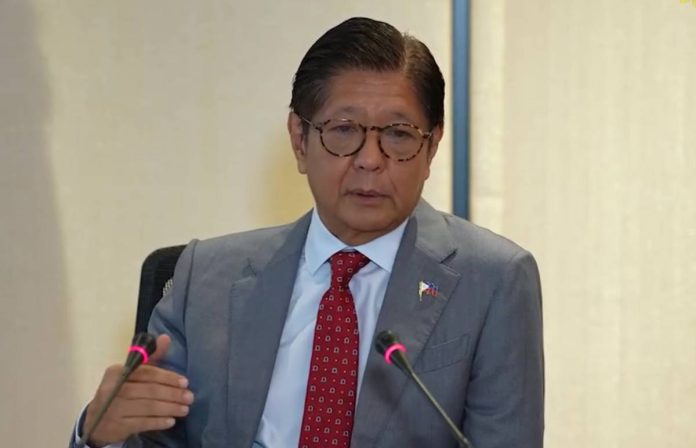
MANILA — President Ferdinand “Bongbong” Marcos Jr. has called on Filipino households to begin storing rainwater as the government prepares for potentially severe water shortages, agricultural losses and disruptions to essential services amid the anticipated Super El Niño.
With prolonged dry conditions threatening the country’s water and food security, Marcos urged the public to take immediate precautionary measures, including purchasing buckets and other containers to collect rainwater while rainfall is still available.
“Bumili na kayo ng balde para ‘pag umulan, makolekta na ninyo lahat,” Marcos told reporters in Singapore.
The President assured the public that the government would distribute water filters and provide instructions on properly treating collected rainwater to prevent waterborne diseases.
“Tuturuan namin kayo…We’ll give you the filter. We’ll teach you how to do everything para hindi kayo magkasakit at maayos ang pag-treat ng tubig, pag-filter ng tubig,” he said.
The administration is also preparing cloud-seeding operations as part of its efforts to address possible water shortages resulting from prolonged drought.
Marcos said the El Niño Task Force had already begun coordinating with concerned government agencies to implement measures aimed at protecting water resources, maintaining food production and ensuring the uninterrupted delivery of essential services.
Agriculture is among the sectors expected to face significant challenges as reduced rainfall and extreme heat could affect irrigation supplies, crop production and farmers’ livelihoods.
To cushion the potential economic impact, the government is considering livelihood assistance and skills training programs for farmers whose agricultural activities may be disrupted by the weather phenomenon.
The President also directed attention to the preparedness of healthcare facilities, emphasizing the importance of securing electricity, generator fuel and adequate medical supplies.
These measures are intended to ensure that hospitals remain operational and capable of responding to illnesses and other health emergencies associated with extreme weather conditions.
The education sector is likewise preparing contingency measures to minimize disruptions to classes during periods of intense heat.
Marcos said alternative learning arrangements must be made available while maintaining face-to-face instruction whenever conditions permit.
“We’retrying to make sure that the alternative modes of teaching are available. But, find ways, as much as possible, to do face-to-face because…iba talaga ‘yung face-to-face kaysa sa remote,” he said.
The President emphasized that in-person learning remains preferable to remote instruction, although schools must be prepared to adopt alternative teaching methods when extreme weather threatens students’ health and safety.
The government’s preparations involve several agencies, including the Department of Science and Technology, Department of Health, Department of Social Welfare and Development, Department of Agriculture and Presidential Communications Office.
The coordinated response is intended to strengthen the country’s readiness against the anticipated Super El Niño, particularly its potential effects on household water supplies, agricultural productivity, public health and education./PN