


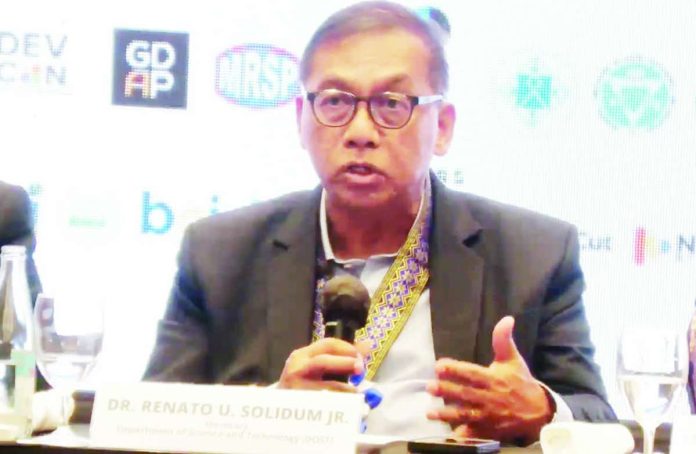
ILOILO City — The proposed Pax Silica artificial intelligence and semiconductor hub must undergo stringent environmental review amid concerns that its massive water and electricity requirements could strain essential resources and affect nearby communities, Science and Technology Secretary Renato Solidum Jr. said.
Solidum stressed that the project remains under negotiation and that the government has yet to receive sufficiently detailed plans to assess its environmental, social and technological implications.
“We don’t have the specific plans yet; it is still being negotiated,” Solidum said during a press conference here on Monday, August 3.
The United- States-proposed high-technology hub in New Clark City, Tarlac is envisioned as a semiconductor and AI ecosystem within the Luzon Economic Corridor.
Available project estimates indicate that it could require approximately 130 million liters of water daily — comparable to the consumption of about 600,000 households — and three gigawatts of electricity, equivalent to around 16 percent of Luzon’s current grid capacity.
Its projected electricity demand is also comparable to the combined output of three coal-fired power plants or a single nuclear facility.
Solidum said negotiations are being led by the Department of Trade and Industry (DTI), while the Department of Science and Technology’s (DOST) role is to promote the responsible use of technology for national development.
“Any project in the Philippines will pass through stringent environmental compliance certification to be handled by the DENR (Department of Environment and Natural Resources),” Solidum stressed.
He said detailed plans must first be submitted to responsible government agencies before the project’s environmental and social consequences can be properly evaluated.
“Before anyone can really discuss the specifics about this project, it has to be presented in such a way you can actually assess based on the matrix that are prescribed by responsible government agencies,” he explained.
The assessment should determine the project’s geographical footprint, its possible effect on forests and water and energy systems, and the number of people who could be displaced or otherwise affected.
“What will they do? Is it simply AI or processing involved? There are many factors we cannot discuss without adequate details,” said Solidum.
Without sufficient safeguards, the project’s enormous resource requirements could place pressure on water and electricity supplies, threaten agricultural productivity and undermine the sustainability of surrounding communities, critics have warned.
Solidum, however, clarified that the DOST is not among the regulatory agencies responsible for issuing environmental permits.
“It is very difficult to discuss things without the details, but definitely, if you are talking about the assurance, there are a lot of environmental laws and considerations that different government agencies, the regulatory ones, must considert,” he added.
Apart from environmental concerns, Solidum said the country must develop a larger pool of specialists capable of supporting the growth of AI and other advanced technologies.
“We need more skilled personnel,” he remarked, noting that the expertise required must correspond to the specific needs of different sectors.
The DOST’s human resource development program supports Filipinos pursuing master’s degrees in the Philippines and abroad. Solidum said the agency has also entered into agreements with international universities to promote technology transfer and collaboration.
Solidum spoke on the opening day of the 2026 Artificial Intelligence Festival, which runs from August 3 to 5 at the Iloilo Convention Center.
Led by DOST Region 6, the festival brings together thousands of innovators, policymakers and participants from Southeast Asia to advance the ethical, practical and collaborative use of AI./PN