

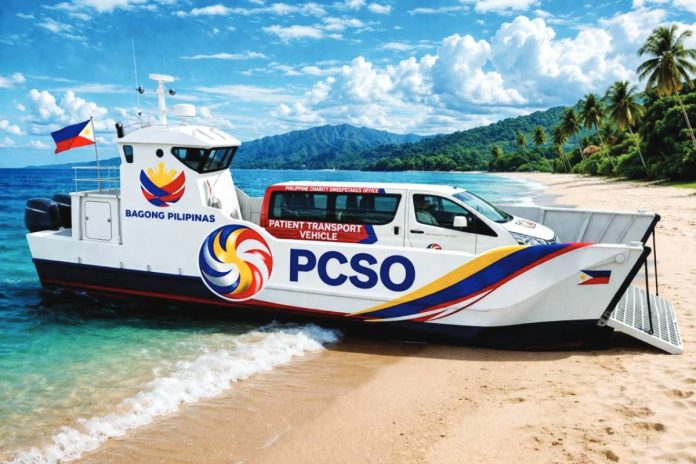
BASCO, Batanes — In line with President Ferdinand Marcos Jr.’s directive to make healthcare more accessible, the Philippine Charity Sweepstakes Office (PCSO) has announced plans to deploy a landing craft vessel (LCV) in Batanes to improve patient transport across its island municipalities.
The vessel is scheduled for deployment later this year.
PCSO General Manager Melquiades “Mel” Robles described the LCV as a “mini roll-on/roll-off (RORO)” vessel that allows ambulances to be loaded directly onboard.
The LCV is expected to enhance patient mobility by facilitating the transport of patients, emergency responders, and essential medical supplies between islands such as Sabtang and Basco. Designed to access shorelines directly, it will enable faster and more efficient transfer of patients to healthcare facilities, especially during emergencies.
“This means the patient can remain inside the ambulance from the point of transport until arrival at the hospital, without the need for repeated transfers,” Robles said.
“Direkta natin silang madadala sa pinakamalapit na pagamutan—isang tunay na door-to-door na serbisyong medikal,” he added.
Robles noted that the initiative aims to address mobility challenges in geographically isolated areas, where access to healthcare is often hindered by sea conditions and limited transportation options.
The LCV will be deployed to provinces with island municipalities, including Batanes, as part of broader efforts to strengthen inter-island healthcare access.
The project will complement PCSO’s existing support through the provision of patient transport vehicles to local government units—resources that are effective on land but limited in areas separated by water.
The need for improved transport was highlighted during a medical and dental mission conducted on March 26–27 in Sabtang and Basco, where PCSO provided consultations, free medicines, and diagnostic services to hundreds of beneficiaries.
The mission also showcased modern medical technology, including a portable, AI-powered X-ray system that enabled on-site screening for tuberculosis and other chest-related conditions. While such innovations bring faster diagnosis to remote areas, reliable transport remains crucial for patients requiring further medical care.
Batanes, with a population of about 18,000, is composed of six municipalities and 29 barangays scattered across islands—making timely access to healthcare an ongoing challenge.
Local officials welcomed the initiative, emphasizing that improved inter-island transport is vital to ensuring prompt medical services for residents in remote communities.
The deployment of the LCV forms part of efforts to strengthen healthcare delivery in geographically isolated and disadvantaged areas (GIDAs).