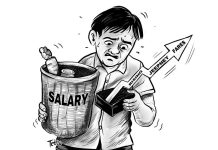




EXCISE is often discussed whenever fuel prices rise in the Philippine, yet many people remain uncertain about what it really means and why it matters. A recent proposal in the House of Representative – allowing the President to suspend or reduce excise taxes on fuel emergencies – has once again brought this issue into the public debate. While the measure is still part of the legislative process, it highlights the continuing challenge of balancing government revenue with the economic burden faced by ordinary Filipinos.
As its core, excise tax is a type of tax imposed on specific goods, usually those considered non-essential or those that have social or environmental impacts. In the Philippines, excise taxes apply to products such as alcohol, tobacco, and petroleum products. Unlike value-added tax (VAT), which is based on the price of goods or services, excise tax is typically imposed as a fixed amount per unit, such as per liter of fuel.
Fuel excise taxes became more prominent with the passage of Republic Act No. 10963, also known as the Tax Reform for Acceleration and Inclusion (TRAIN) Law. Under this law, excise tax on petroleum products were gradually increased to help generate funds for infrastructure projects and social services. For instance, the excise tax on gasoline rose to P10 per liter, while diesel reached P6 per liter after the scheduled increases were completed in 2020.
Supporters of the excise tax argue that it plays an important role in the government financing. Revenue from such taxes helps fund public programs such as transportation infrastructure, social protection initiatives, and other development projects. These funds are crucial for economic growth, particularly in a developing country where government resources needed to improve public services.
However, excise taxes on fuel also have a direct impact on everyday life. Because fuel is used in transportation, electricity generation, and logistics, higher fuel costs can influence the price of goods and services. When fuel prices increase, public transportation fares, delivery costs, and food prices may also rise, creating additional pressure on household budgets.
This concern partly explains the recent legislative proposal that would grant the President authority to suspend or reduce fuel excise taxes during period of unusually high oil prices or national emergencies. Lawmakers supporting the measure argue that it could provide temporary relief to consumers when global oil prices surge. Some proposals suggest that excise taxes could be suspended for several months if international crude oil prices reach certain thresholds.
Yet the issue is not without debate. Some economic managers have previously pointed out that suspending fuel excise taxes could significantly reduce government revenue. In fact, earlier estimates suggested that suspending such taxes could lead to tens of billions of pesos in lost revenue annually – funds that might otherwise support public programs.
Ultimately, the discussion about excise tax reflects a broader policy question: how can the government protect consumers while still maintaining the financial resources needed for national development? There is no single answer. Policymakers must weigh the immediate relief that tax suspension could bring against the long-term need for stable government funding.
For many Filipinos, understanding excise tax is important because it affects daily expenses, from transportation fares to the price of goods in the market. As debates continue in Congress, the issue reminds us that taxation is not merely a technical policy matter – it is closely tied to economic stability, social welfare, and ethe everyday realities of Filipino life./PN