



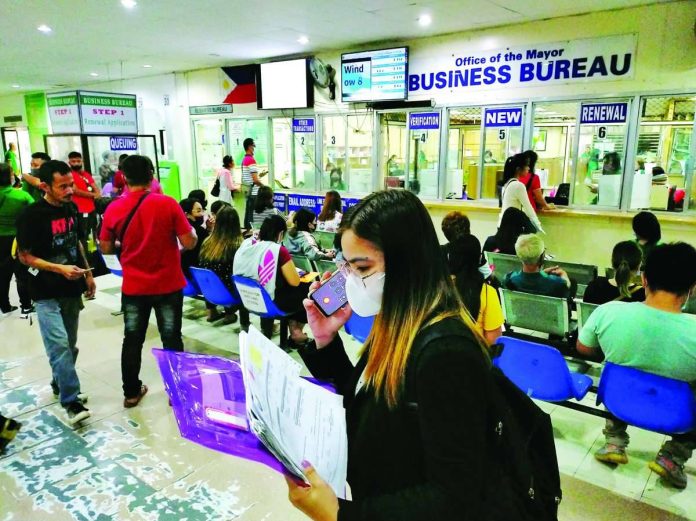
BUSINESS groups are working with the Anti-Red Tape Authority (ARTA) to help speed up the process of getting business permits in the Philippines.
In a statement, the Philippine Chamber of Commerce and Industry (PCCI) said it will activate its 126 local chambers to work as decentralized one-stop shops for receiving and processing complaints under the Ease of Doing Business Act.
The PCCI said this helps the government identify in real time the bottlenecks to getting a business permit, particularly the duplicative requirements and inconsistent processing times.
The PCCI said it will work hand-in-hand with ARTA to encourage micro, small, and medium enterprises (MSMEs) to give feedback on their business permit application process so problems can be solved quickly.
The business group said that the slow processing of business permit applications in the Philippines hurts MSMEs the most.
“For the 1.24 million MSMEs comprising 99.63 percent of business establishments that employ 6.25 million workers who compose 66.58 percent of the country’s workforce, these aren’t mere inconveniences — they’re existential threats,” the PCCI said.
Aside from the PCCI, the Philippine Ease of Doing Business Foundation (Ease.PH) will also ask industry groups to see how leading economies streamline permits in manufacturing, services, and other critical sectors to help guide reforms in the Philippines.
The groups hope to achieve a minimum 50 percent reduction in processing times for identified permits by the fourth quarter of 2026.
There will also be monthly “Progress Reports” that identify specific delay points, and a recognition program for top-performing local government units to incentivize compliance. (ABS-CBN News)