



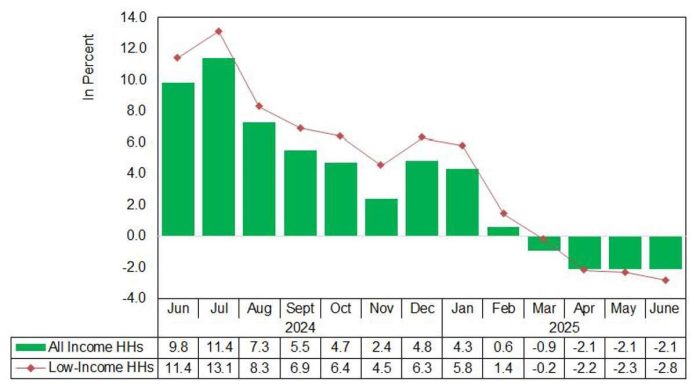
GUIMARAS – This island province recorded a continued decline in food inflation in June this year, marking the fourth straight month of deflation for both all income and low-income households (HHs), with rates at -2.1% and -2.8% respectively, data from the Philippine Statistics Authority (PSA) showed.
“Among the inflation for low-income households, the decline was largely driven by a sharper drop in the prices of meat and other parts of slaughtered land animals, with 6.1 percent inflation rate in June compared to 7.5 percent the previous month,” Provincial Statistics Officer Nelida B. Losare said.
She explained, “The meat and other parts of slaughtered land animals group contributed 28.8 percent to the overall food inflation for the bottom 30 percent income households.”
Other commodities that influenced the downtrend in food inflation for low-income group included cereals and cereal products, which fell further to -9.3 percent from -9.1 percent, and vegetables, tubers, plantains, cooking bananas and pulses, which slowed to -8.2 percent from -7.1 percent.
The top contributors to the food inflation rate for low-income households were cereals and cereal products with 3.83 percentage points (136.7 percent share), Vegetables, tubers, plantains, cooking bananas and pulses with 0.83 percentage points (29.7 percent share), and oils and fats with 0.17 percentage points (6.1 percent share).
For all income households, the top contributors to the overall food inflation were cereals and cereal products with 2.83 percentage points (134.7 percent share), vegetables, tubers, plantains, cooking bananas, and pulses with 0.92 percentage points (44.0 percent share), and oils and fats with 0.09 percentage points (4.2 percent share).
While the overall rate remained stable, individual food groups posted varied price movements. Annual increases were observed in flour, bread and other bakery products, pasta products, and other cereals (3.5 percent from 1.9 percent), fish and seafood (1.3 percent from -0.5 percent), fruits and nuts (7.5 percent from 7.3 percent), and sugar, confectionery, and desserts (0.8 percent from 1.2 percent).
Conversely, from May to June, slower inflation was observed in several key food items. Cereals and cereal products slightly declined further to -8.5% from -8.4%, while meat and other parts of slaughtered land animals dropped to 6.0% from 7.2%.
Inflation for milk, other dairy products, and eggs eased to 3.8% from 4.5%, oils and fats fell to -7.2% from -6.4%, and vegetables also recorded a sharper decline at -8.8% from -7.0%.
Meanwhile, ready-made food and other food products also registered slower inflation, down to 0.8% from 1.2% in May.
Losare also elaborated that food inflation in Western Visayas maintained a downward trend in June this year, with Guimaras and two other provinces registering deflation, while the remaining provinces recorded slower price increases.
The current rate is a sharp reversal from the 9.8 percent food inflation recorded in Guimaras in June 2024, reflecting a significant 11.9 percentage point drop over the past 12 months. The deflation was driven by continued price declines in key food items such as rice, meat, vegetables, dairy products, and oils.
Aklan posted the steepest drop in the region, recording -4.8 percent in June from -3.9 percent in May. Antique followed with -4.5 percent from -3.5 percent, both sustaining deeper deflationary trends since April 2025. In contrast, Capiz and Iloilo provinces maintained positive food inflation rates at 0.9 percent and 0.2 percent, respectively, though both were lower than their May figures.
Losare further explained that across all five provinces, food inflation has consistently declined over the past 13 months. Aklan recorded the most significant drop, from 11.9 percent in June 2024 to -4.8 percent in June 2025.
“Antique fell from 8.6 percent to -4.5 percent, Capiz from 8.3 percent to 0.9 percent, and Iloilo from 7.4 percent to 0.2 percent. Guimaras’ decline was the third steepest in the region,” Losare said./PN