

THE National Irrigation Administration (NIA) is taking bold steps to shield Filipino farmers from market shocks while boosting the country’s rice productivity through contract farming, high-tech irrigation, and climate-resilient reforms.
At the center of this push is NIA administrator Eduardo Guillen, who outlined a multipronged strategy aimed at achieving food security and farmer profitability — without additional burden on government.
“So far, magda-dalawang taon na po ang programa natin. Maganda naman ang epekto at marami tayong natutulungan,” said Guillen at the Bagong Pilipinas public briefing, referring to NIA’s contract farming scheme.
Under this program, he said, farmers are assured of a buying price ranging from P21 to P25 per kilo — well above market rates. Eighty percent of their harvest is sold at market price, while 20% is bought at P29 per kilo for buffer stocking.
However, higher buying prices are just one part of the equation. Guillen then stressed the need to empower farmers as full participants in the entire value chain — from planting to processing to marketing.
“Hindi dapat magtapos sa pagbenta ng palay. Sa co-op, kikita rin sila sa milling at distribution. Ibabalik ‘yan sa kanila bilang dividends,” Guillen said.
To do this, NIA is organizing irrigators’ associations into one cooperative per town, which are then prioritized by the Philippine Center for Postharvest Development and Mechanization (PhilMech) for rice processing systems (RPS) and other mechanization support.
So far, NIA has helped build over 300 cooperatives and more than 200 rice processing centers nationwide.
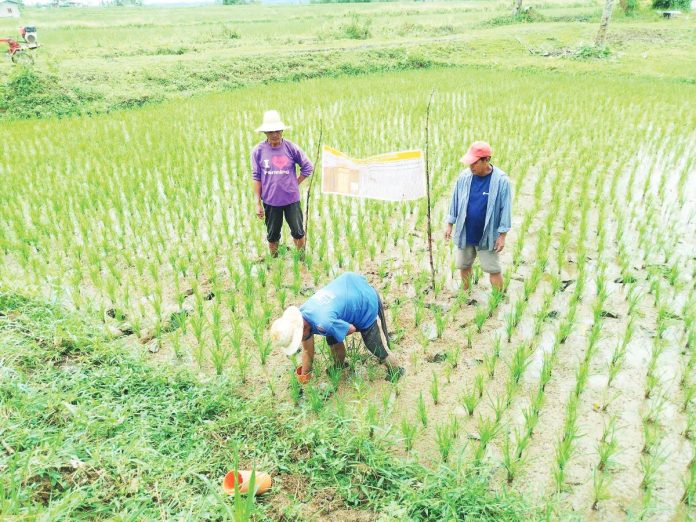
To boost yields without waiting for new irrigation facilities, NIA is also changing the way farmers farm — starting with cropping calendars.
“Binago namin ang cropping schedule. October ang tanim, aanihin ng February. March tatanim ulit, aanihin ng July,” Guillen explained.
This system — dubbed double dry cropping — avoids typhoons, ensures more sunlight, and improves yields, especially under irrigated conditions. It also aligns with what NIA calls climate-smart agriculture.
Another innovation is the Alternate Wetting and Drying (AWD) irrigation technique which, according to the NIA, helps farmers cut water use by up to 30% while improving crop health and root development.
The added bonus? Farmers can earn carbon credits from this method due to lower methane emissions.
“Nakatipid ka na sa tubig, may kita ka pa sa carbon credit. At mas mataas pa ani,” Guillen said.
NIA is also expanding solar-powered irrigation systems, especially in off-grid and upland areas, replacing diesel pumps and slashing farmers’ input costs.
What sets these systems apart is their built-in AI technology, which provides weather forecasts and planting recommendations.
While national programs are in place, Guillen emphasized that local government units (LGUs) hold the key to sustaining these reforms — especially in marketing and land support.
He also called on LGUs to use their National Tax Allotment (NTA) funds to build warehouses and support local cooperatives. (GMA Integrated News)