

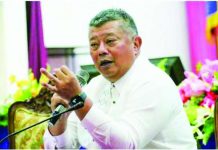


TO REITERATE, this series is called “That Ilonggo writer” because that’s what I’m referred to by people on the account of my online writing workshops.
Of course, it can mean “that Ilonggo writer who has the gall to teach creative writing.”
But also, “that Ilonggo writer who can, and who did.”
Either way, I’m happy to be “that Ilonggo writer.”
And so I continue with what I do best.
*
The first draft is like a cake from the oven.
The final poem, a decorated wedding cake complete with royal icing.
*
More and more, I like to advocate writing the first draft.
There’s planning.
There’s actual labor.
There’s getting stuck trying to find the perfect word.
I used to write pretty much that way.
*
God knows how many poems and stories have been aborted because I couldn’t get past the imperfection of the third sentence, or the seventh line.
And then, I reached some kind of maturity.
Some sense of resignation that I cannot write the perfect poem, or the perfect story, in just one sitting.
It’s hard to admit that.
But once I did, I just got better at writing.
*
I used to write my columns in one sitting, confident that I could beat the newspaper deadline.
And then, I started writing pieces weeks, maybe days, in advance.
Because I have days gained before the deadline, I actually have time to reread, and improve much of my work before I submit on the day before my deadline.
So it happens that on rereading, I gain more ideas, more insights that were not even considered on the first writing.
And to be honest, this has greatly improved my articles.
*
Where before I write myself from start to 800 or so words (that, or nothing) at one sitting for my column pieces, I now have an appreciation for writing 300 or 400 words for my first draft.
This way, I can write drafts for three or four article a day.
Imagine me on a Thursday thinking and writing about three columns (M-W-F) for the next week.
Then, I have Friday, Saturday, and Sunday to elaborate on the drafts I have written.
I really feel that my best works are short—300 or 400 words.
But since I have word requirements to meet (I don’t know why, but newspapers like 700 to 1,200 words), I try to be less an asshole, and just give my editors and publishers what they want.
*
The trick for me, therefore, is to go back to my short piece, and pad it with funny and wonderful stuff until I reach the 800-word mark that is kind of my favorite nowadays.
So yeah, I like the work of padding, salvaging, elaborating, expanding, and extending my short drafts.
But I would only work on short drafts that have a complete story arc already.
Drafts that are pretty much done from start to finish.
*
The first draft lets me know I am working on something that I have already finished.
It tells me that I can stop anytime, and still have something to show.
These days, I rarely show or submit first drafts.
I guess, I have learned some humility, too.
Where before I thought that my first drafts are flawless because I wouldn’t write on until I find the perfect word, now I am okay with blanks or XXX marks that would indicate the missing word.
Then, when I give my writing a rereading at least three times, I just see that I’m getting better every time I retouch my work.
*
So yeah, I am a believer in first drafts now.
And I teach it in my workshops.
I always tell people, Write to the finish.
Even if you feel it is crappy.
Because it’s always easier, and better, to improve something than be sorry for not starting anything at all./PN
